The V&A
The Marginalia Messenger's London
In 1857, when the collections arrived in South Kensington, the first director, Henry Cole, described the result, with some honesty, as "a refuge for destitute collections". They had begun in 1852 as the Museum of Manufactures, in rooms at Marlborough House that Prince Albert had offered.
The Brompton Boilers
The earliest buildings in South Kensington, put up in 1856, were iron sheds clad in corrugated iron, which The Builder called "hideously ugly" and named the Brompton Boilers. Queen Victoria opened the South Kensington Museum on 20 June 1857. The Boilers were taken down in 1867 and their ironwork shipped east to Bethnal Green, where, rebuilt with brick walls and a slate roof, they now house Young V&A.
Dinner in three classes
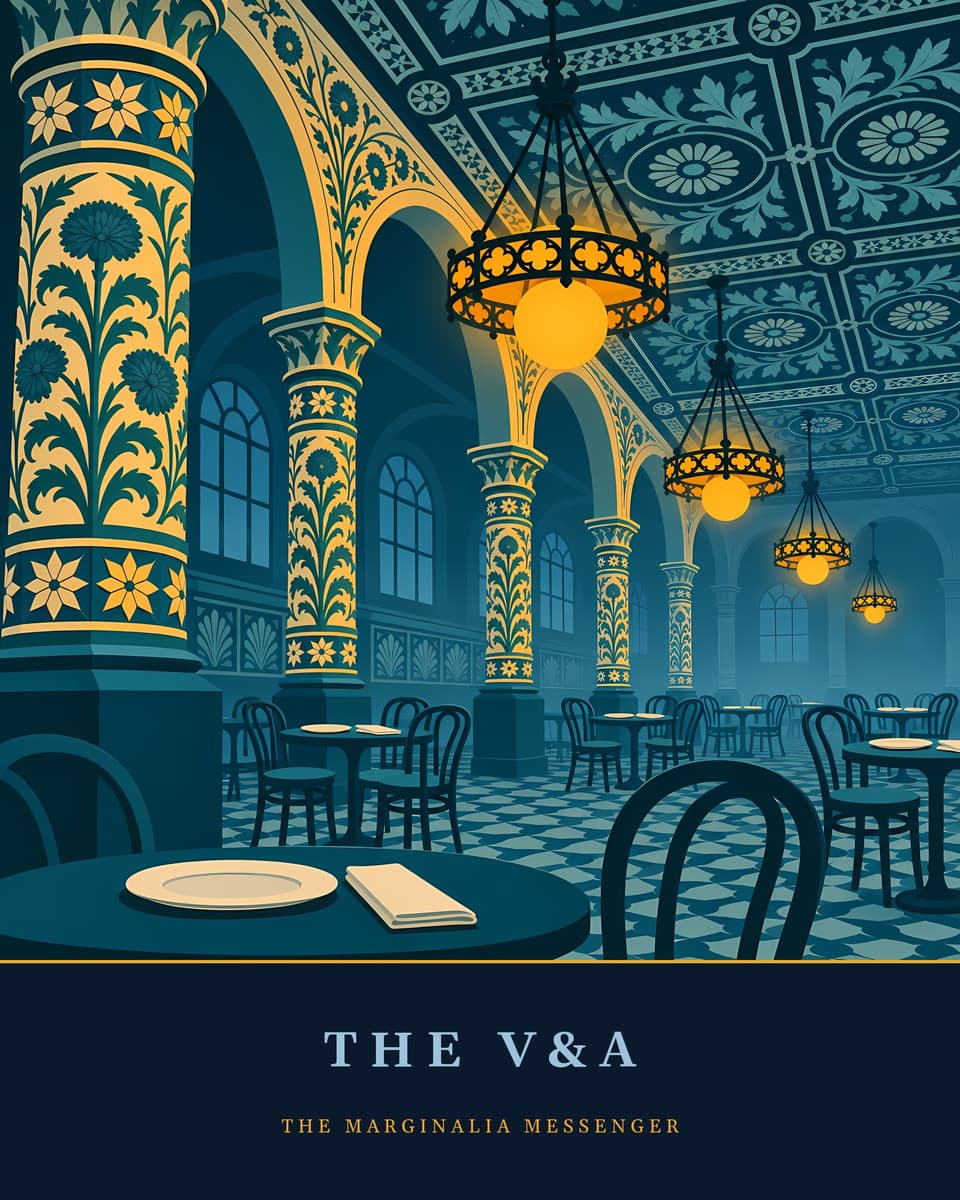
Cole wanted the museum used by as many people as possible. The iron galleries of 1856 included a refreshment room, which made the South Kensington Museum the first in the world with a public restaurant. There were first- and second-class menus, and a third class for working people.
In 1858 gas lighting allowed the galleries to open in the evening. Cole said the aim was to find out "what hours are most convenient to the working classes", and he hoped the museum might draw a few of them away from the gin palace. Between 1866 and 1881 the refreshment rooms were decorated by William Morris and Philip Webb, by James Gamble and by Edward Poynter, and the three rooms are still there. Cole's dog Jim is buried in the museum garden.
A floor by prisoners and a leaf on hooks
The Architectural Courts, now the Cast Courts, opened in 1873. They were built 25 metres high to take a plaster cast of Trajan's Column, which was still too tall and stands in two halves, side by side. The tiled floor was laid by women prisoners at Woking, and it became known as the "opus criminale".
The courts also hold a cast of Michelangelo's David, more than five metres tall, sent to Queen Victoria from Tuscany in the 1850s. She is said to have been shocked. A plaster fig leaf was made. For royal visits it hung on the statue from two hooks. It is now shown separately, behind the pedestal. In 1928 a report advised getting rid of all the casts as "injurious to students", and was ignored.
'For ages'
On 17 May 1899 Queen Victoria laid the foundation stone of Aston Webb's new front, and the new name, the Victoria and Albert Museum, was announced at the ceremony. In her speech she trusted that it would remain "for ages" a source of refinement and progress. Edward VII opened the building on 26 June 1909. Bombs fell on Exhibition Road in 1940 and 1941, and the pockmarks they left in the stone have been kept.
The V&A today
From South Kensington station the subway, a pedestrian tunnel, leads to the museum. Late in the day, the old refreshment rooms are the best place in the museum to sit down.
Find the V&A on the map of the novel's London · The Marginalia Messenger