The Strand
The Marginalia Messenger's London
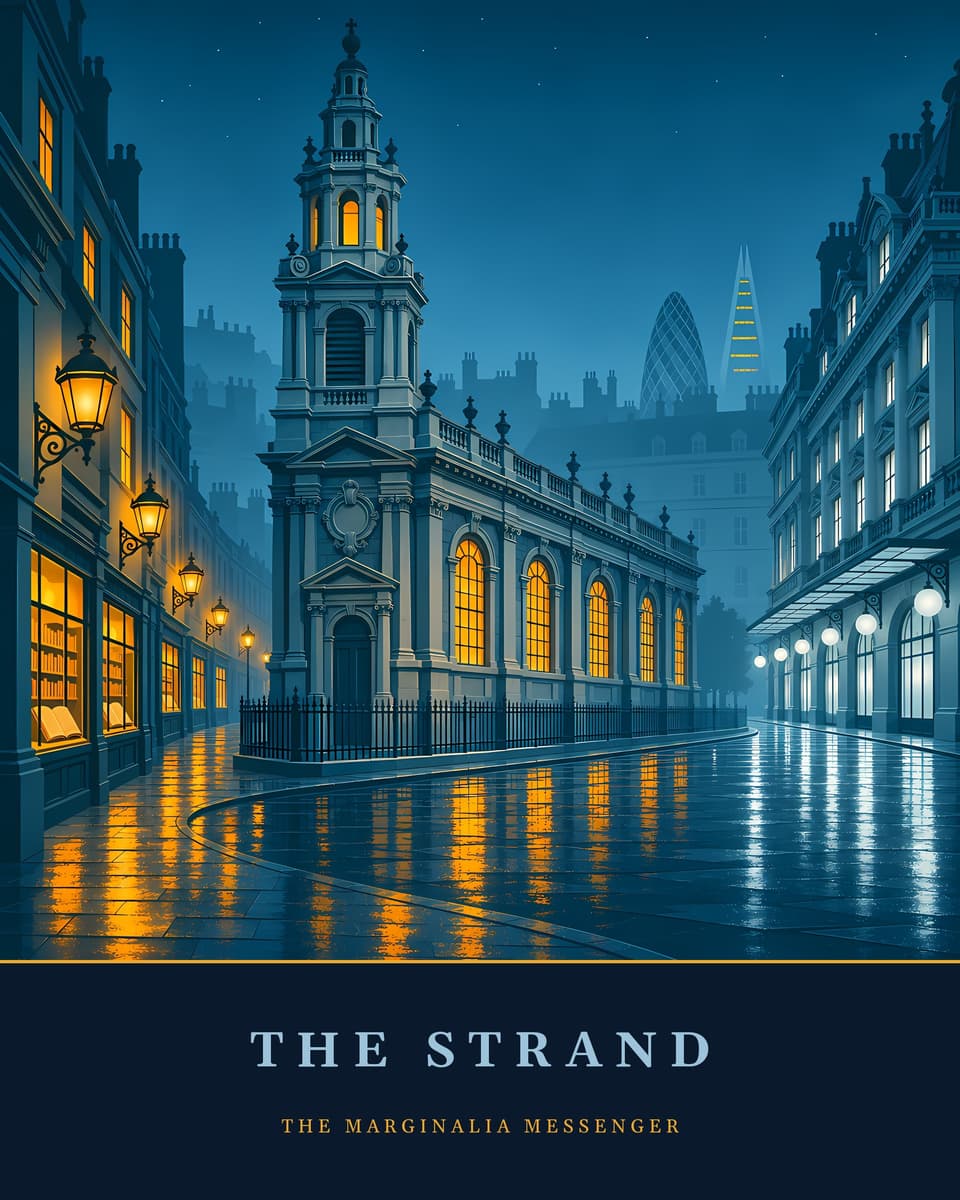
A strand is a shore, and this was one. Before the Victoria Embankment was built in the late 1860s, the street ran along the bank of the Thames, and the houses on its south side had their gardens running down to the river. The Strand appears on the map of the novel's London.
Palaces on the shore
Bishops and nobles built their London houses here, with the road at the front door and the river at the back. Wat Tyler's rebels destroyed John of Gaunt's Savoy Palace in the Peasants' Revolt of 1381. Somerset House, rebuilt from 1776 to William Chambers's designs as a palace of government offices, had the river lapping its south wing and a great arch through which boats could come inside. By 1885 the Embankment had pushed the water away, and the building held the Inland Revenue and the national register of births, marriages and deaths.
The elephant at the Exchange
Early in the nineteenth century the Exeter Exchange on the Strand kept a menagerie upstairs. Its star was Chunee, an Indian elephant who had appeared on stage at Covent Garden and Drury Lane, rang a bell at nine each evening and took coins from visitors. Lord Byron met him in 1813 and thought his manners so good that he wished the elephant were his butler.
By 1826 Chunee was in pain from a bad tooth and dangerous. He refused poisoned food, and on 1 March soldiers were brought from Somerset House to shoot him. It reportedly took about 150 musket balls. The public then paid a shilling each to watch the dissection, and some people ate the meat. The Exchange was pulled down in 1829.
Tea, chess and roast beef
Thomas Twining opened at No. 216 Strand in 1706 and the firm still sells tea from the same address, under a sign of 1787 said to be the oldest company logo in continuous use.
In 1828 Samuel Reiss opened a smoking room called the Grand Cigar Divan, which became the home of English chess. The caterer John Simpson joined him in 1848, and roast joints began to arrive at the tables on silent trolleys, reputedly so as not to put the players off their moves. Later a chef at Simpson's would not allow the French word "menu" and insisted on "bill of fare". Further along, at No. 96, the French-born perfumer Eugène Rimmel sold scent and cosmetics. His name is still the word for mascara in Italian and Spanish.
Mr Carte breaks a bulb
On 10 October 1881 Richard D'Oyly Carte opened the Savoy Theatre, just off the Strand, with Gilbert and Sullivan's Patience. It was the first public building in the world lit entirely by electricity, with about 1,200 lamps and a generator on open ground nearby. On 28 December, when the stage itself went electric, Carte smashed a glowing bulb in front of the audience to show that it was safe.
In 1885 the Strand had more theatres than any street in London, the new Royal Courts of Justice at its eastern end (opened in December 1882, after their architect had died) and Charing Cross station at the other. The Savoy Hotel came only in 1889, and The Strand Magazine in 1891.
The Strand today
Charing Cross station is at the western end and Temple at the eastern, with Embankment close by. In winter there is skating in the courtyard of Somerset House.
Find the Strand on the map of the novel's London · The Marginalia Messenger