Stationers' Hall
The Marginalia Messenger's London
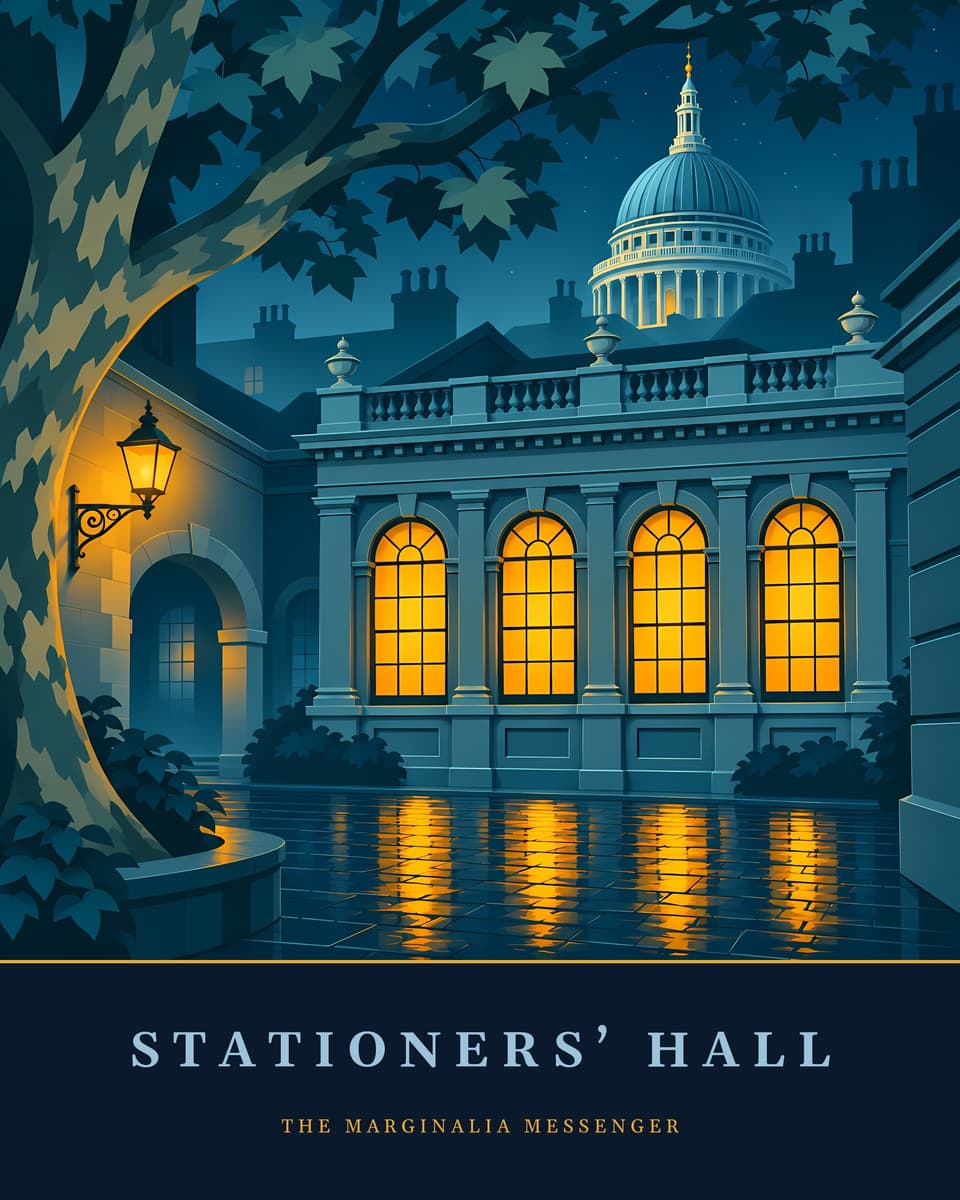
Stationers' Hall stands in a courtyard behind Ludgate Hill, reached through an archway off Ave Maria Lane. Most people walking up to St Paul's go straight past it. The name goes back to the medieval book trade around the cathedral, where the scribes, illuminators and booksellers who kept fixed stalls were called stationers. The City approved their guild in 1403, and Mary I gave it a royal charter in the 1550s.
An unwanted honour
The Stationers took dress seriously. A 1635 order told its senior members to come to the Hall on court days in ruffs; anyone found in a falling collar "or other unseemly habit" forfeited twelve pence. Gowns were compulsory on Lord Mayor's day.
Promotion to the livery was an honour, though not always a welcome one, since it came with fines and fees. Members who declined were threatened with legal action. Among them were Jacob Tonson and Richard Bentley, who were to be sued for "refusing the clothing of the Company". Before the writs were issued, "they submit and are received."
Cakes and ale
Some time around 1612 the bookseller John Norton, a former Master, left money for a sermon at St Faith's, under St Paul's, every Ash Wednesday, with cakes, wine and ale for the members. Bills from the later seventeenth century show one Thomas Averley supplying nearly a thousand penny cakes a year. In 1948 the Company made do with tea; the cakes and ale came back in 1949. The sermon is now preached on Shrove Tuesday, and pancakes have joined the menu.
From 1680 the Company kept a state barge for the Lord Mayor's procession to Westminster. Its freemen wore long gowns of light blue flannel with yellow facings. While the new Lord Mayor was being presented to the Barons of the Exchequer, the Stationers rowed across to Lambeth Palace, and the Archbishop of Canterbury sent them a hamper of wine. One nineteenth-century account puts the gift at sixteen bottles, with copies of the Stationers' almanacs going the other way. The last barge was sold in 1849, and the river procession itself ended in 1856.
An earl's house and a joiner's panelling
Early in the seventeenth century the Company bought the town house of the Earl of Abergavenny and ran a large business from it. Within forty years the old house was in such poor repair that the annual dinner had to be held elsewhere, and money was being raised to rebuild when the Great Fire of 1666 destroyed it. The new hall was finished in the early 1670s. The panelling was fitted by Stephen Colledge, known as "the Protestant joiner".
The Court Room was added in 1748. In 1800 Robert Mylne, Surveyor of St Paul's and architect to the Company, gave the hall its present stone front, although the Stationers had refused to admit him to their freedom, which did not stop them from employing him. In 1940 bombs badly damaged the building, and after the war the ceiling of the main hall was put back to the design of 1800.
Music for St Cecilia
From 1683 the Musical Society of London celebrated St Cecilia's Day each November, and for many years the feast was held in the Hall. In 1692 Henry Purcell's ode for the saint had its first performance here. According to a report of the time, it was so well received that it was sung twice.
Stationers' Hall today
St Paul's station is the nearest. The Hall is used for dinners, weddings and filming, and a door from its garden leads into the church of St Martin within Ludgate.
Find Stationers' Hall on the map of the novel's London · The Marginalia Messenger