St Paul's Cathedral
The Marginalia Messenger's London
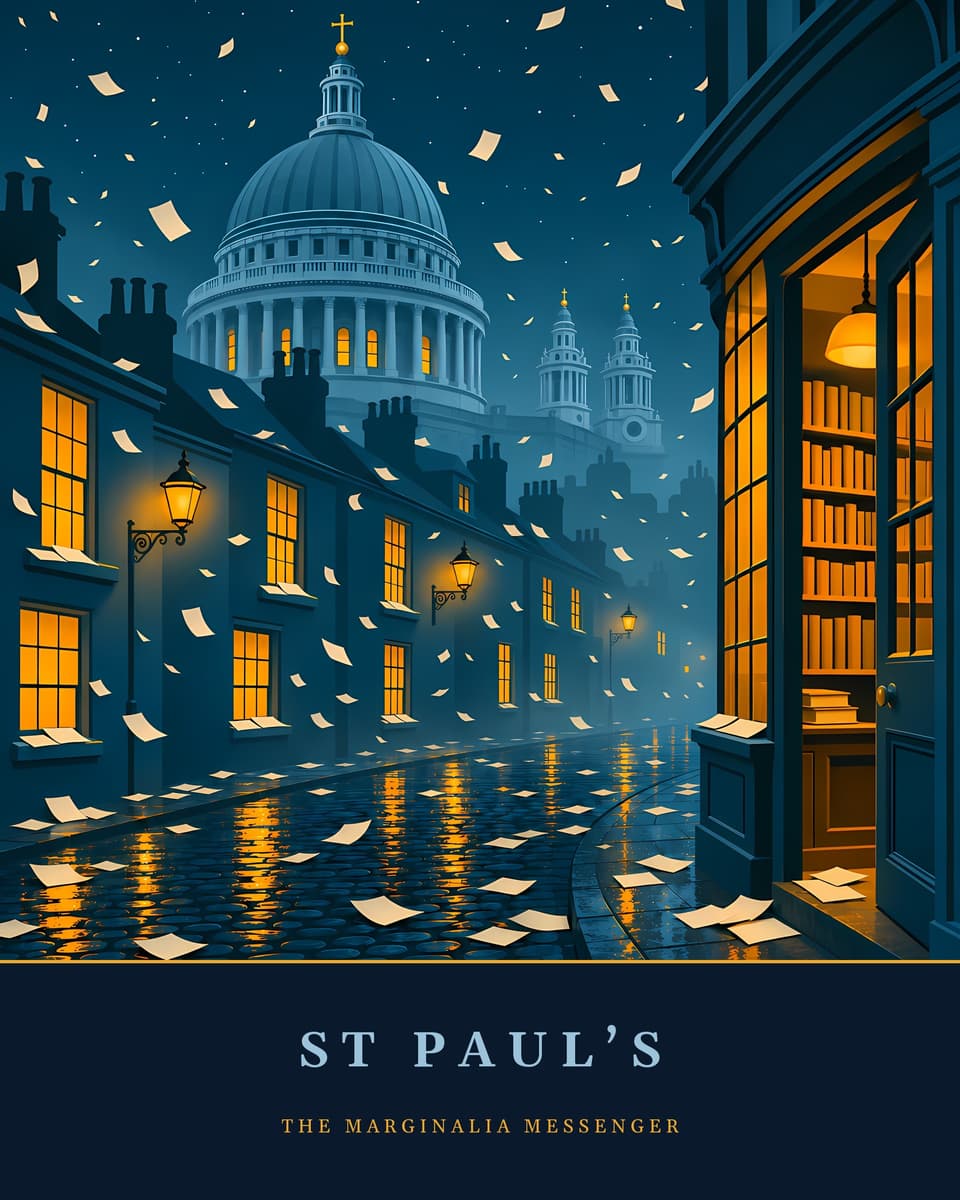
St Paul's sits at the top of Ludgate Hill, and for about as long as books have been printed in England they have been sold in its shadow. Long before Wren's dome, the churchyard of the old cathedral was a market of shops, stalls and signboards, and by the early sixteenth century no part of London, or of England, did more of the country's bookselling. The cathedral is part of the novel's 2025 London.
Shakespeare at the sign of the Angel
The shops in the churchyard had no numbers. They went by their signs: a title page named the seller's sign as his address. In 1597 the earliest printed Richard III gave its seller as Andrew Wise, "at the Signe of the Angell" in Paul's Churchyard, and the title pages of many plays by Shakespeare and his contemporaries carry addresses like it.
Much of the early trade was in foreign hands. In 1484 an Act of Richard III's only parliament exempted foreign printers and booksellers from rules meant to keep foreigners out, and the king is said to have intervened in person. A little over a century later his own story was on sale in the same churchyard, and it did not flatter him.
The news, before newspapers
Before there were newspapers, Londoners gathered in the long nave of Old St Paul's to hear what was happening at court, in Parliament and abroad, and the people who spread the news were called news-mongers. There was business as well, along with pickpockets and the latest fashions. Mary I and Elizabeth I both issued proclamations against bargaining in the nave. In 1628 John Earle called the nave "the land's epitome". Ben Jonson set a scene there in 1599, and a century later Alexander Pope was still warning that "Paul's church" was no safer from talkative critics than the churchyard outside.
A withheld salary
The Great Fire of September 1666 left the old cathedral a shell, and Christopher Wren was given the job of replacing it. The first service in the Quire was held in 1697, with the dome still to come. The last stone went onto the lantern in October 1708, and Parliament declared the building complete on Christmas Day 1711. For a time his salary was withheld. He was buried in the crypt in 1723.
Children's books and fever powder
The booksellers came back after the rebuilding. In 1745 John Newbery moved to 65 St Paul's Churchyard and called his shop the Bible and Sun. His A Little Pretty Pocket-Book cost sixpence, and for twopence more a child got a ball or a pincushion with it. Newbery also sold Dr James's Fever Powder, a patent medicine that his books advertised with some enthusiasm. Samuel Johnson, whom he published and helped to support, nicknamed him "Jack Whirler". The Newbery Medal, an American children's book prize, has carried his name since 1922.
St Paul's today
The nearest station is St Paul's.
Find St Paul's on the map of the novel's London · The Marginalia Messenger