St Pancras
The Marginalia Messenger's London
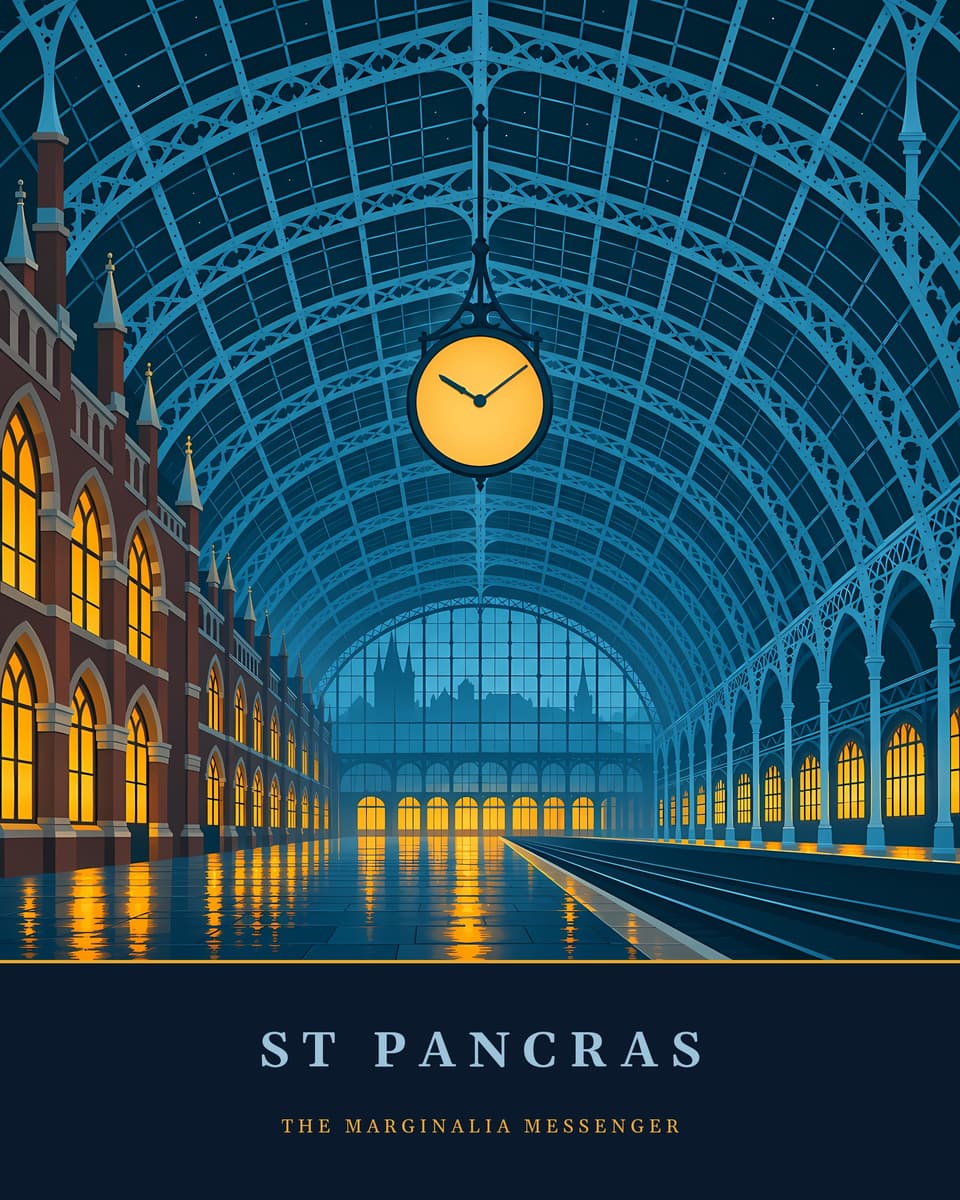
Behind the long red Gothic front of St Pancras, next to King's Cross, is a great iron and glass shed. The station exists because of a traffic jam. The Midland Railway's trains had been running into London on another company's lines, and in 1862, when the International Exhibition drew visitors from all over the country, the delays were severe. The Midland decided to build its own way in. The station opened on 1 October 1868, and the first train was an overnight mail from Leeds. The station is part of the 2025 London of The Marginalia Messenger.
A roof, and a great deal of beer
William Henry Barlow designed the train shed as a single arch, about 73 metres wide and 30 metres high, and when it was finished it was the largest single-span roof of its kind in the world. Underneath the platforms the railway built a storage level for beer brought down from Burton upon Trent. The columns down there were spaced to a unit of length based on the beer barrel, so the building is, in a sense, measured in beer.
A grand hotel without bathrooms
In 1865 the Midland held a competition for a hotel across the front of the station. George Gilbert Scott won with a design for some 300 rooms, which was larger and dearer than the brief had asked for. The Midland Grand opened its east wing on 5 May 1873 (the rest followed in 1876) with hydraulic lifts, fireproof floors, gold leaf on the walls and a fireplace in every room. None of the rooms had a bathroom. Scott's design had one more floor than was ever built, though the railway's publicity went on showing it.
By the 1930s the plumbing and the army of servants needed to carry chamber pots and baths had become too expensive. The hotel closed in 1935, and the building became railway offices. In 1996 the Spice Girls filmed the video for "Wannabe" on its main staircase. It opened again as a hotel in 2011, and the formal reopening fell on 5 May, the same date as in 1873.
Mr Hardy's homework
To reach its new terminus the Midland had to cut through the old churchyard of St Pancras, just to the north. In the mid-1860s, the story goes, the architect Arthur Blomfield was asked to supervise the removal of the graves, and he passed the work to his young assistant, Thomas Hardy, who had not yet published a novel. He was in his mid-twenties. An ash tree in the churchyard, ringed with old headstones stacked against its trunk, became known as the Hardy Tree, although the link to Hardy himself is thin. It fell in December 2022.
Saved by a poet
In the 1960s British Rail planned to knock down both station and hotel. John Betjeman, Jane Hughes Fawcett and the Victorian Society led the opposition. In November 1967 station and hotel were listed Grade I. The demolition plans were dropped in December 1968. In November 2007 the station became the London terminus for Eurostar, and that month a bronze Betjeman by Martin Jennings was unveiled on the upper level of the shed, looking up at the roof.
St Pancras today
Under Barlow's roof the light turns from grey to blue at dusk, and the red brick of the hotel warms as the lamps come on.
Find St Pancras on the map of the novel's London · The Marginalia Messenger