The Reading Room, British Museum
The Marginalia Messenger's London
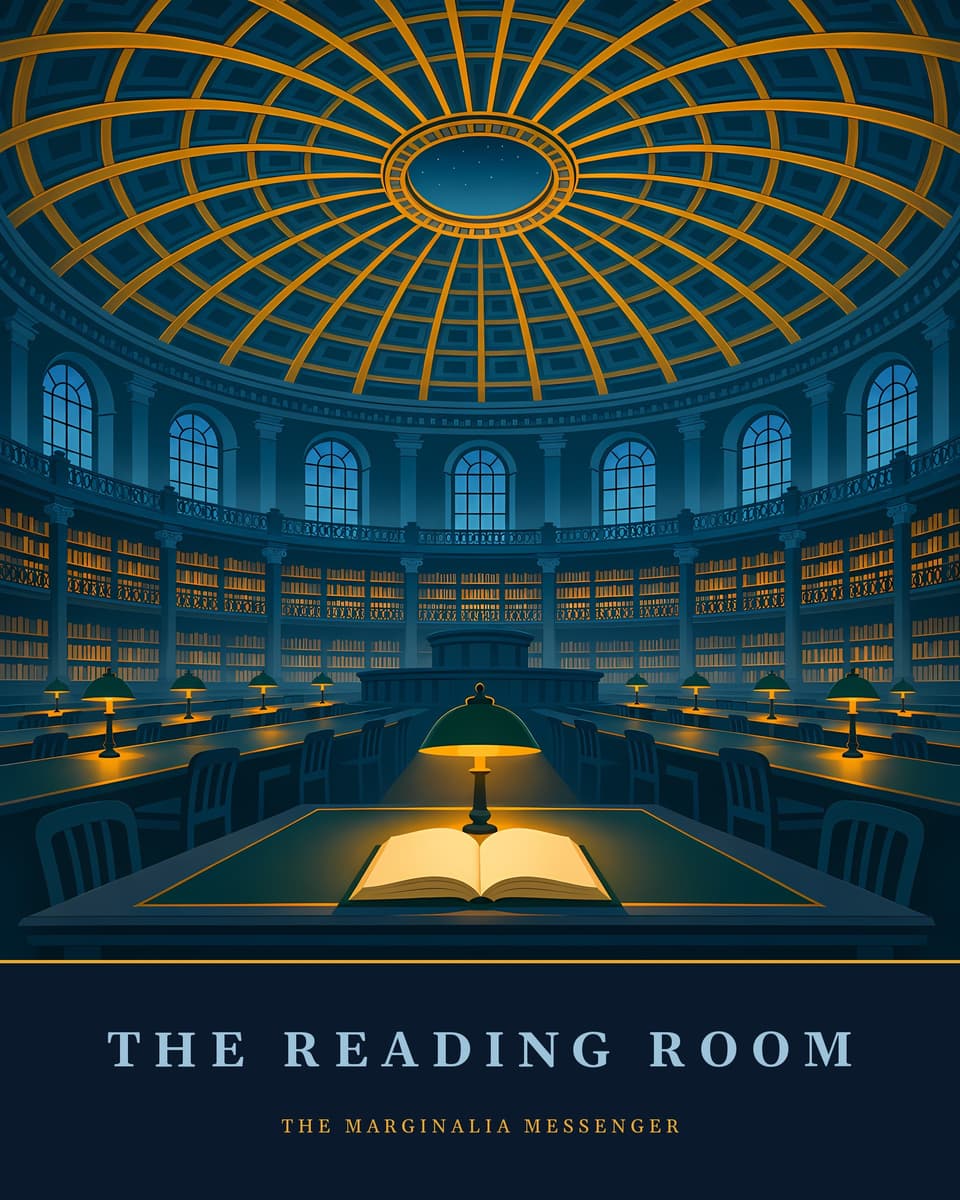
"The Reading Room itself resembled a cathedral of learning, its circular design and soaring dome creating an atmosphere of secular worship."
The round Reading Room stands in the middle of the British Museum, in what used to be an open courtyard. Antonio Panizzi, the Keeper of Printed Books, wanted a circular room there, and Sydney Smirke built it between 1854 and 1857 from cast iron, concrete and glass. The dome, 42.6 metres across, was modelled on the Pantheon in Rome. It is less solid than it looks. The ceiling is papier-mâché, hung from an iron frame. Iron book stacks surrounded the room; by the time the books left there were about 40 kilometres of shelving.
Champagne on the catalogue desks
The room opened on 2 May 1857 with a breakfast. Guests were served champagne and ice cream on the catalogue desks, a use the desks were not designed for and never saw again, as far as anyone knows. From 8 to 16 May, more than 62,000 people came in to look, each holding a ticket with a plan of the library on it.
After that the sightseers were shown out. To read here you applied in writing, and the Principal Librarian decided who got a ticket.
Dr Richter studies the land question
In April 1902 a Russian couple calling themselves Dr and Mrs Jacob Richter took rooms in Holford Square, near King's Cross. The doctor soon applied for a reader's ticket, saying, according to the historian Helen Rappaport, that he had come "to study the land question". He was Vladimir Ulyanov, better known as Lenin, and he used the alias to keep out of sight of the Tsar's police. Years later an elderly porter remembered him as a "very nicely-spoken gentleman".
He was in large company. Karl Marx, Oscar Wilde, Bram Stoker, Arthur Conan Doyle and Mahatma Gandhi are all said to have worked under the dome. In A Room of One's Own (1929) Virginia Woolf describes standing under it "as if one were a thought in the huge bald forehead".
An appointment for 3 June 1997
In 1916 Max Beerbohm published "Enoch Soames", a story about a minor poet who sells his soul for one afternoon in the Reading Room a hundred years in the future. He wants to see what posterity thinks of him. The date he is sent to is 3 June 1997. He finds a single mention of himself, in an article about a story by Max Beerbohm.
When the day came, a small group of Beerbohm's admirers went to the Reading Room to see what would happen. One of them was the magician Teller. He later wrote in The Atlantic that a man who matched Soames's description came in, looked through the catalogues and then slipped away among the stacks. A magazine later suggested that Teller had arranged the whole thing. He has never said.
Beerbohm chose his date with some luck. That autumn the British Library moved to St Pancras, and the Reading Room closed to readers on 25 October 1997.
The Reading Room today
The British Museum is on Great Russell Street, with Tottenham Court Road, Holborn and Russell Square stations round about. The Reading Room has been open to visitors again since 2024; check the museum's website before you go. Stand in the middle and look up.
Find the Reading Room on the map of the novel's London · The Marginalia Messenger