Old Broad Street
The Marginalia Messenger's London
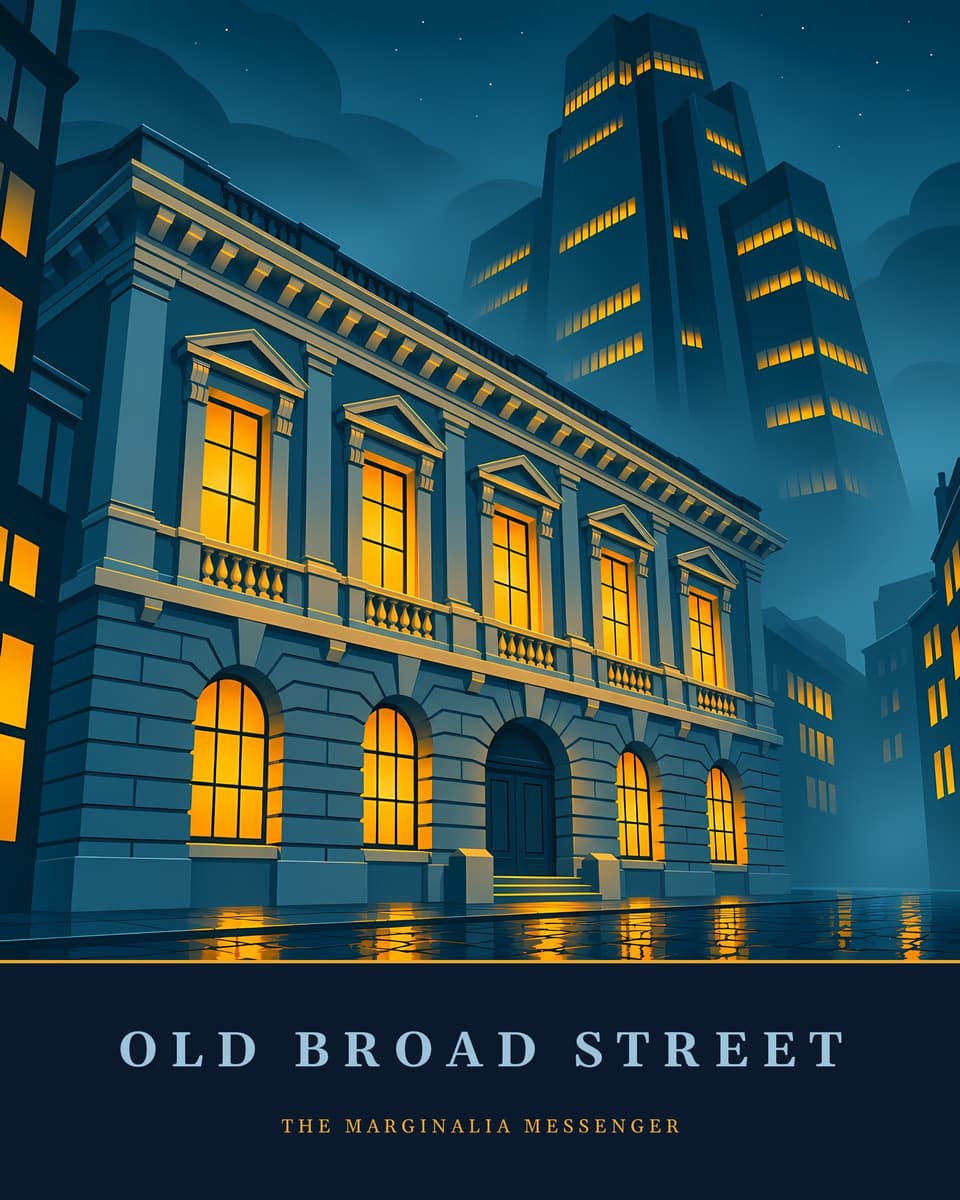
Old Broad Street runs from the corner of Threadneedle Street up towards Liverpool Street. In the reign of Charles I it was still "one of the most fashionable streets in London", and Gilbert Talbot, Earl of Shrewsbury, had lived here under Elizabeth. Then the money arrived and the earls left, which in the City is the usual order of events.
A steward among the Venetians
In the seventeenth century Venetian workmen made glass in a house here. Its steward for a time was the writer James Howell. He could not bear the heat of the place, gave up the post, and said that had he stayed much longer he would have "melted to nothing" among the Venetians. The house later became Pinners' Hall, then a chapel for Dissenters. In February 1660, a few months before the Restoration, General Monck dined with the Lord Mayor and then quartered his troops at the old glass-house, with crowds cheering him all the way.
A college in a merchant's house
In 1563 the financier Sir Thomas Gresham built a mansion with a square court and gardens running from Bishopsgate through to Broad Street. He left it to found a college. From 1597, the year after his widow died, its professors lectured every day but Sunday, in Latin in the morning and in English in the afternoon. The scientific meetings held around those lectures grew into the Royal Society, which Charles II chartered.
The college had its characters. Sir Kenelm Digby withdrew there for two or three years after his wife's death. Dr John Woodward, the Gresham professor of physic, once drew swords on his rival Dr Richard Mead. As the story is told, Mead had the advantage and ordered Woodward to beg for his life; Woodward replied that he would not, until he was Mead's patient. He gave in all the same.
By Dr Johnson's time the lectures had almost no audience. In 1768 the house was pulled down and the Crown built an Excise Office on the site. When that was taken down, workmen found a large Roman mosaic below it in 1854. At its centre a figure reclined on a panther, of which only three paws and the tail were left.
The willow and the nightcap
After the dissolution of the monasteries, the grounds of the Austin Friars, just off the street, went to William Paulet, later Marquess of Winchester. Paulet kept royal favour under four very different sovereigns. Asked how he had managed it, he is said to have answered: "By being a willow, and not an oak." His great house nearby stood until 1839. The friars' church went to London's Dutch congregation.
The surgeon Sir Astley Cooper kept his City practice in Broad Street before he moved west. The story goes that a grateful old patient, after a painful operation, flung his nightcap at him. Cooper said he would "pocket the affront", and did; at home he found a draft for a thousand guineas inside.
Broad Street station
On 1 November 1865 Broad Street station opened at the top of the street as the terminus of the North London Railway. Around 1900 it was the third-busiest station in London, with more than 27 million passengers in 1902. Buses, trams and the Underground drew them away over the following decades, until the station closed on 30 June 1986 and the Broadgate development was built over the site.
At No. 19, Philip Hardwick's Palladian building has housed the City of London Club since 1832; a plan to sell it for offices was refused permission in 1970. A few doors along rises the former National Westminster Tower, completed in 1980 and the tallest building in Britain until 1990. Seen from above, its plan resembles NatWest's three-chevron logo.
Old Broad Street today
Bank and Liverpool Street stations are each a few minutes' walk away. On a weekday evening it empties quickly.
Find Old Broad Street on the map of the novel's London · The Marginalia Messenger