Mayfair
The Marginalia Messenger's London
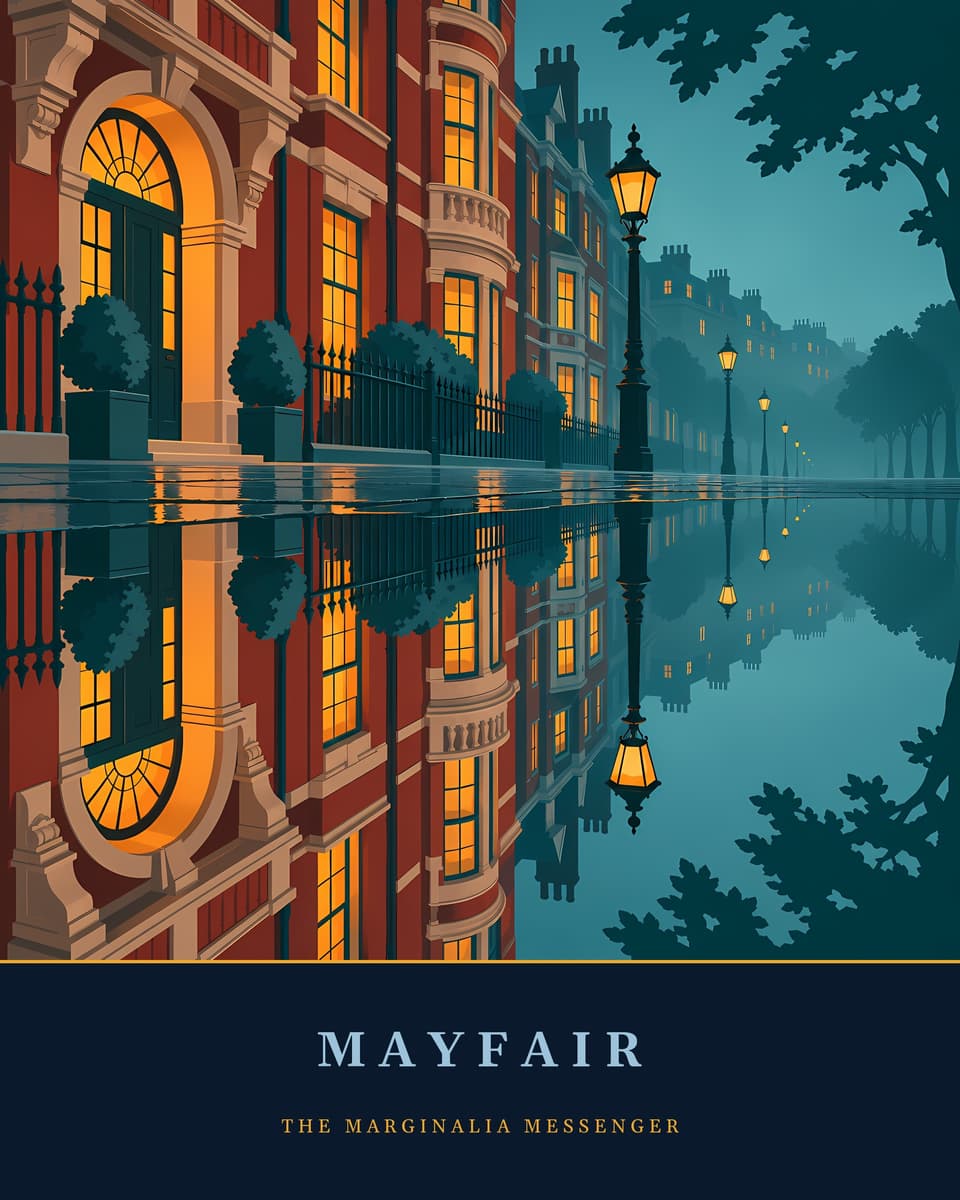
"Outside the restaurant, the April evening had turned cool, a light mist falling on Mayfair's exclusive streets."
Mayfair has been expensive for a long time. It is the square mile or so between Oxford Street, Regent Street, Piccadilly and Park Lane, and its name comes from a fair. In The Marginalia Messenger it is part of Liv's London, in 2025.
Semolina and bare knuckles
Every year from 1 to 14 May a fair was held on a stretch of open ground called Great Brookfield, where Curzon Street and Shepherd Market are now. It had moved there in 1686 from the Haymarket, which it had outgrown. The attractions included bare-knuckle fighting, women's foot races and semolina-eating contests. By the reign of George I the May Fair had become a byword for disorder, and the 6th Earl of Coventry, who lived on Piccadilly and could presumably hear it, led a campaign against it. It was abolished in 1764.
Weddings by the guinea
In 1730 Alexander Keith became the first minister of the new Curzon Chapel. He began marrying couples without banns or a licence, and in 1742 a church court excommunicated him. He went to prison, where he stayed for several years, and the weddings carried on in a chapel of his own close by. A newspaper advertisement of 1744 offered the licence, the minister's and clerk's fees and the certificate together for a guinea, with the chapel open until four in the afternoon. At its height, the chapel is said to have married thousands of couples a year. When his wife died in January 1750, Keith announced her death in the Daily Advertiser, next to an advertisement for the chapel.
The most famous of these weddings took place on Valentine's night in 1752. According to Horace Walpole, the Duke of Hamilton decided at a party at Bedford House that he would marry Elizabeth Gunning that night, and found a clergyman who refused him for want of a licence and a ring. They went on to Keith's chapel and were married there at half past midnight, with a ring from a bed curtain. The Marriage Act of 1753, in force from 1754, put an end to it.
Handel at No. 25, Hendrix at No. 23
George Frideric Handel was the first person to live at 25 Brook Street. He lived there from 1723 until his death in 1759, and he wrote Messiah and the Music for the Royal Fireworks there. In 1968 and 1969 Jimi Hendrix rented a flat on the upper floors of No. 23, next door. Handel's house has been a museum since 2001. It is hard to imagine either of them complaining about the noise.
Nancy Mitford behind the counter
In 1757 an Italian confectioner, Domenico Negri, opened the Pot and Pine Apple in Berkeley Square. It became Gunter's, a fashionable place to eat an ice, and it stayed in the square until the east side was pulled down in the 1930s.
On 3 August 1936 Heywood Hill opened a bookshop at 10 Curzon Street, on ground where the May Fair had once been held. In the last years of the Second World War the shop was kept going by Lady Anne Gathorne-Hardy with Nancy Mitford behind the counter. A blue plaque on the front records Mitford's years there. The shop still sells books from the same address.
Mayfair today
Green Park and Bond Street stations sit at its edges. On a wet evening the side streets are almost empty.
Find Mayfair on the map of the novel's London · The Marginalia Messenger