Marylebone High Street
The Marginalia Messenger's London
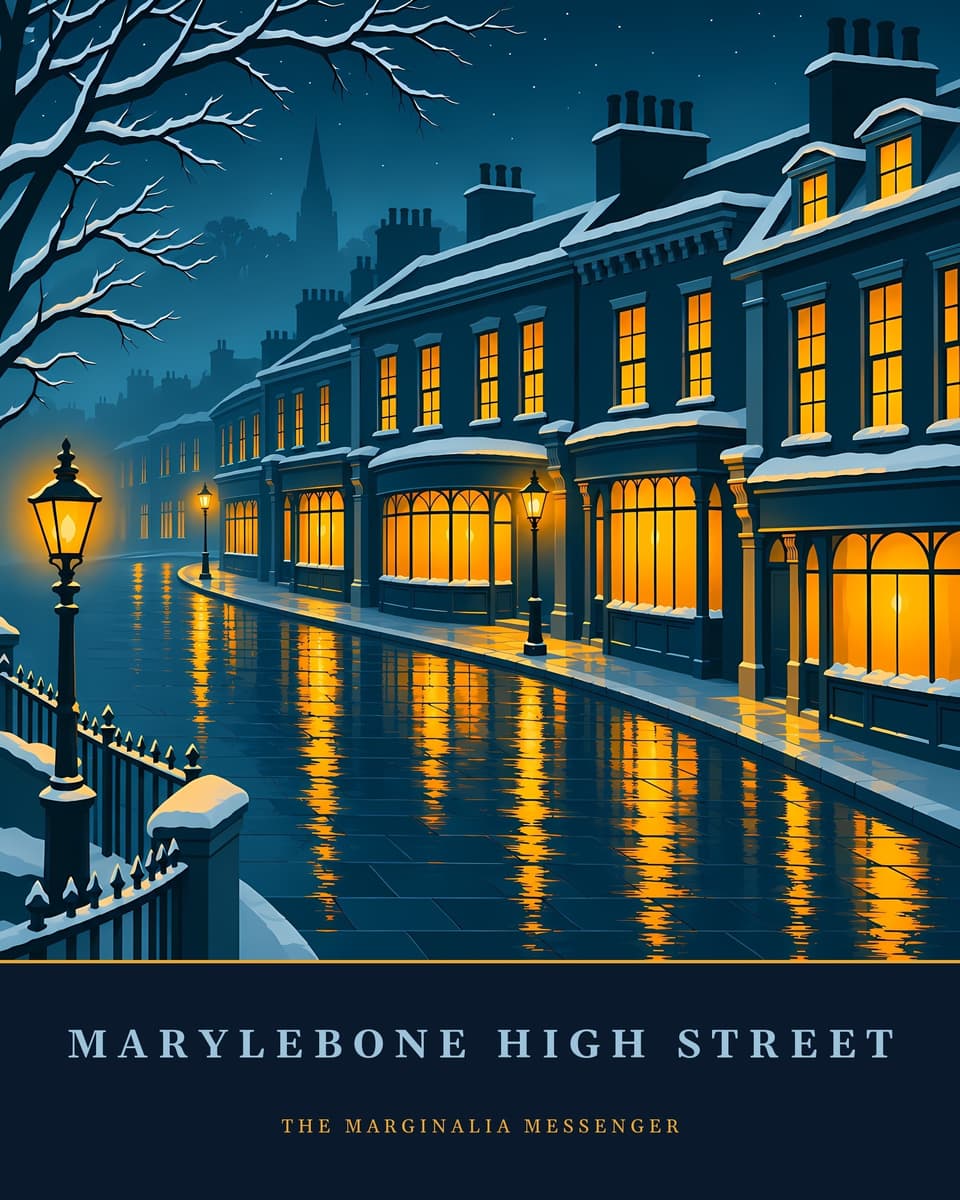
"The city seemed paradoxically muted, yet every noise rang out with startling clarity through the stillness."
Marylebone High Street still bends like a village street, and that is what it was. The village grew up beside the Tyburn brook, and soon after a parish church was built at the north end around 1400, the street became its centre. Most of the buildings you see date from about 1900, when the estate that owns the land rebuilt it shop by shop.
A pretty place, then a noisy one
Behind the Rose tavern there were bowling greens, and on 7 May 1668 Samuel Pepys walked in the garden there for the first time and noted that "a pretty place it is". The greens became Marylebone Gardens, and from 1738 they were a place for concerts and entertainments, with Handel's music among the attractions. John Gay had already made the gardens a haunt of the highwayman Macheath in The Beggar's Opera of 1728, which cannot have helped the tone.
The fireworks did the rest. From 1772 Signor Torre's displays were so ambitious that the neighbours objected, and the manager, the composer Samuel Arnold, was taken to court. The gardens closed for good after the 1776 season, and their organ was auctioned the following April. A man named John Castles had also opened a shell grotto nearby in 1738, which is said to have drawn royalty. It is remembered now by Grotto Passage.
A font, a rake and a funeral
The old parish church stood at the top of the High Street. Francis Bacon was married in an earlier building on the site in 1606, and in 1735 Hogarth set the wedding scene of A Rake's Progress inside it. Its successor saw Lord Byron baptised in 1788. In the same year Charles Wesley, the hymn writer, died; he had asked to be buried in the churchyard, and eight clergymen carried his body there. The old church came down in 1949. Its site is now a small garden of rest, with a memorial to Wesley near where he lies.
A bookshop since 1860
In 1860 a bookseller named Francis Edwards moved into the building then numbered 83A. He began with theology. Under his son, also Francis, the shop became an antiquarian bookseller, with a growing line in travel, topography and maps. In 1908 Edwards paid for a costly rebuilding by the architect W. Henry White, in red brick with stone dressings and shaped gables; the date 1910 is carved on a shield under the attic windows. At the back he put a long gallery lit from above, which the Survey of London counts among the country's most distinguished interiors.
The Edwards business left in the late 1970s. After some years as Read's of Marylebone High Street, the shop passed around 1990 to James Daunt, who specialised at first in travel books.
Marylebone High Street today
Baker Street and Regent's Park stations are both nearby.
Find Marylebone High Street on the map of the novel's London · The Marginalia Messenger