Leicester Square
The Marginalia Messenger's London
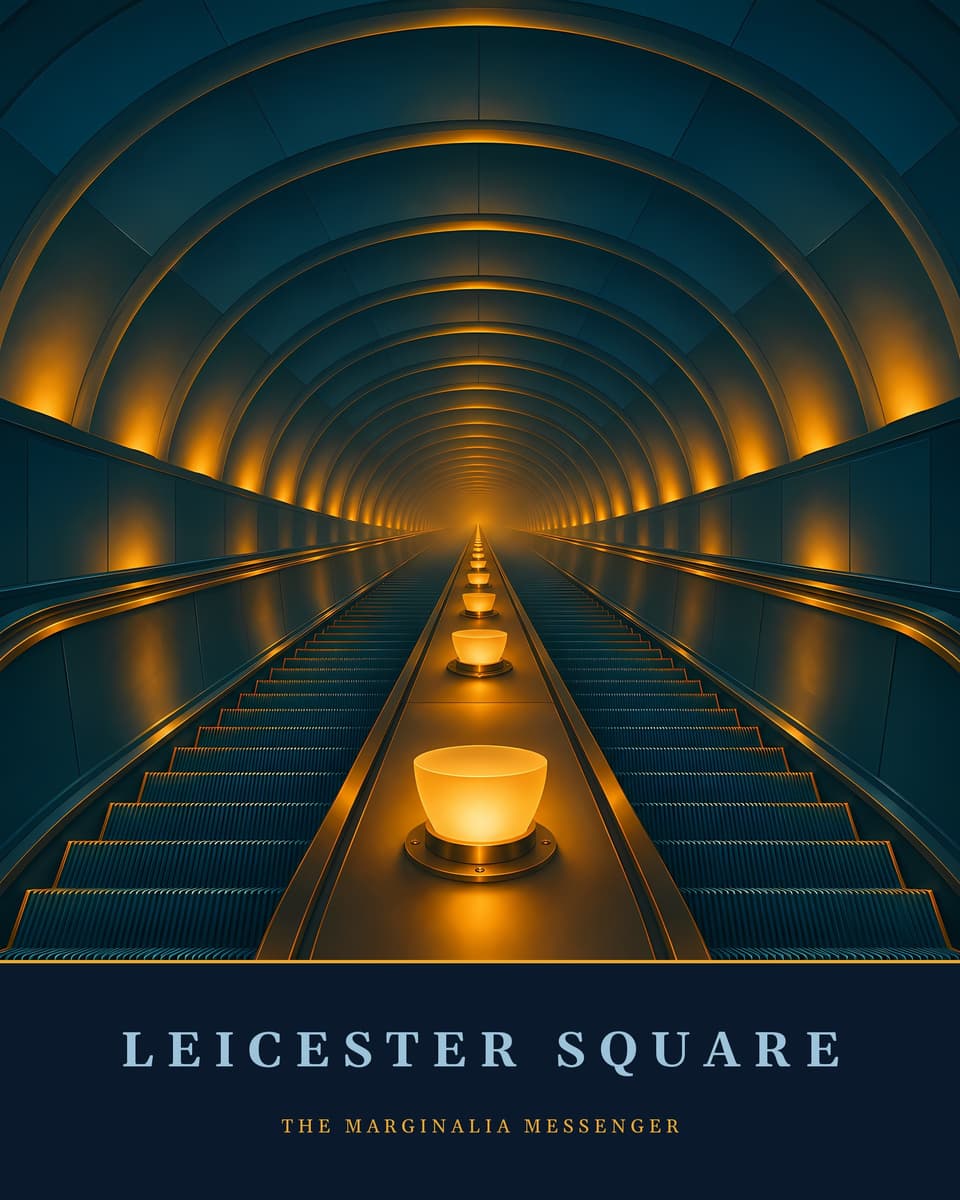
Today Leicester Square means cinemas and premieres; its history is odder. In the first chapter of The Marginalia Messenger it is Liv Harrington's Tube station, the one she uses to get to her shop in Cecil Court.
The Earl and the parishioners
In 1630 Robert Sidney, Earl of Leicester, bought the fields here, and by 1635 he had built Leicester House. Fencing in the land cut off the parishioners of St Martin's from the grazing they had always had there. They complained to Charles I, whose arbitrators from the Privy Council made the Earl keep part of the field open. That open ground is the square.
Houses followed. Hogarth lived at No. 30 from 1733 until 1764, and Joshua Reynolds at No. 47 from 1760 until 1792. In 1726 No. 27 briefly housed Mary Toft, who claimed to have given birth to rabbits and had a surgeon prepared to vouch for her. The story ended when she was caught trying to buy a rabbit.
The king under the globe
In the middle of the garden stood a gilded lead statue of George I on horseback, which nobody looked after. In 1851 the mapmaker James Wyld leased the garden and built his Great Globe, big enough to walk inside: visitors entered and climbed a staircase to see the continents modelled on its inner walls. Admission was a shilling. Punch compared the heat inside to a baker's oven, and one modeller was dismissed for putting California in England. The statue was simply buried under the works, and when Members of Parliament asked after it, Wyld explained that it was only lead stuffed with clay.
The globe came down in 1862 and the king came back up, in poor shape. One night in October 1866 pranksters gave him a dunce's cap, a broomstick and a coat of painted spots. He was later sold for £16.
Mr Hunter's back door
In 1783 the surgeon John Hunter moved into No. 28 with his museum and his students. Bodies for dissection were said to come in through the back. He also acquired the skeleton of Charles Byrne, the "Irish Giant", who had asked to be buried at sea to avoid exactly that. The house is often named as Stevenson's model for Dr Jekyll's, though the claim is popular and unproven.
A gift from Baron Grant
By the 1870s the garden was a dump. In 1874 Albert Grant, born Abraham Gottheimer, an MP and company promoter with an Italian barony, bought it for £11,060, had it laid out with a fountain and a statue of Shakespeare, and gave it to the public. It opened on 3 July 1874. Grant's company promotions had lost other people a great deal of money, and he was later bankrupt more than once. He died poor in 1899.
In 1885 the square was a place of music halls and late nights. The Alhambra had burnt down in December 1882 and reopened a year later, and the new Empire Theatre had opened on the north side in 1884. Theatrical agents took offices in the old houses around them.
Leicester Square today
Leicester Square station (Northern and Piccadilly lines) is a minute's walk away. The square is pedestrian and lit at all hours, with a bronze Charlie Chaplin and Shakespeare still on his fountain.
Find Leicester Square on the map of the novel's London · The Marginalia Messenger