King's Cross
The Marginalia Messenger's London
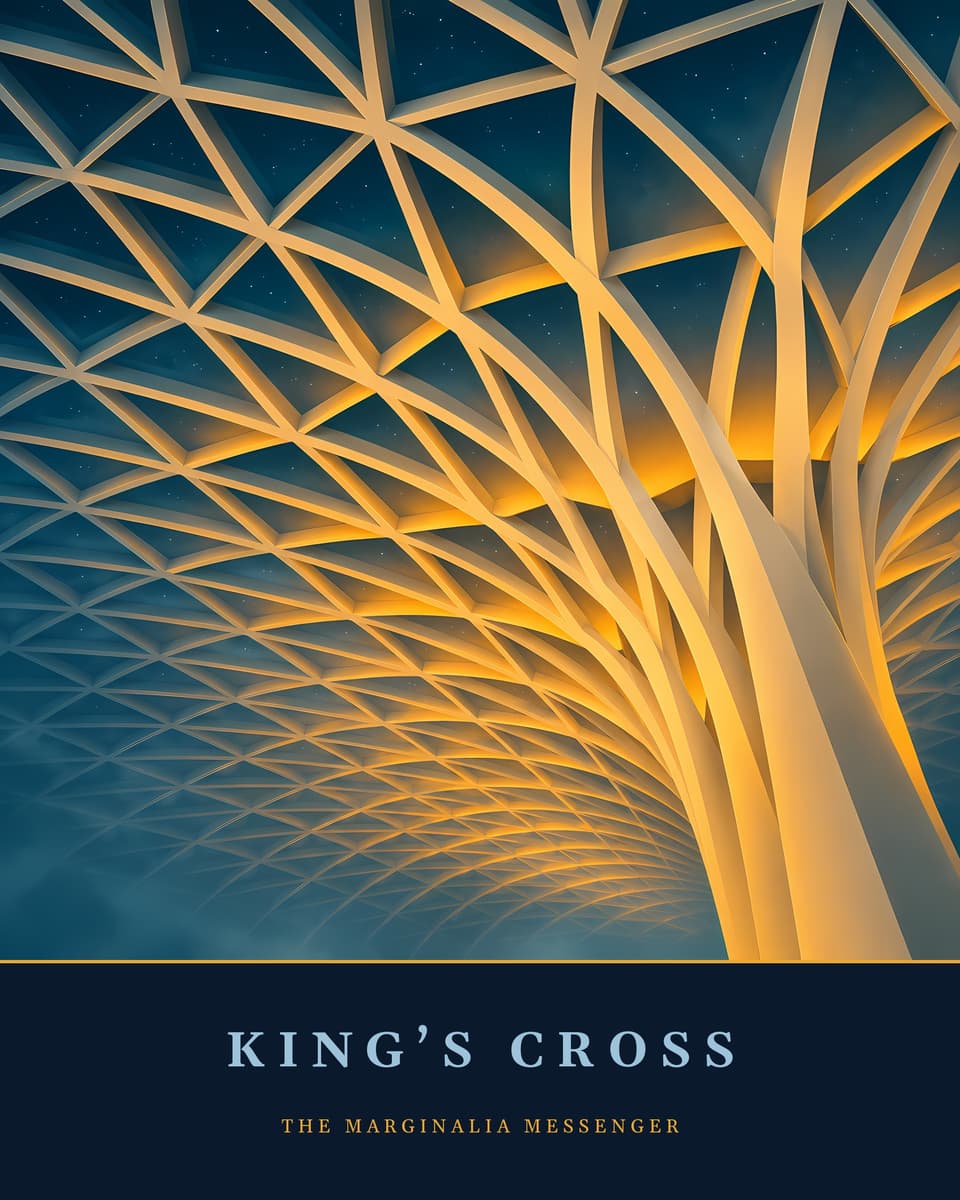
"The streets narrowed as she approached King's Cross, Victorian terraces yielding to modern developments. Construction barriers channelled pedestrians through temporary walkways, the city's endless revision of itself made manifest in concrete and steel."
King's Cross is a railway terminus and the district around it, where the Euston Road, the Pentonville Road and the Gray's Inn Road meet. It is one of the stations of the novel's 2025 London. Until the 1830s it had another name. It was Battle Bridge, after an old crossing over the River Fleet.
Boudica, probably not
The name Battle Bridge gave rise to a tradition that the Romans defeated Boudica and the Iceni here in AD 60 or 61. Tacitus, who wrote the account of that battle, does not say where it took place. The further claim that the queen lies buried under platform 9 or platform 10 of the station seems to have grown up only after the Second World War.
A king on a pedestal
In 1830 a monument to George IV went up at the crossroads, designed by Stephen Geary: an octagonal tower carrying a statue of the king. It was not admired. The upper storey held a camera obscura; the base was used as a police station and later as a pub. Walter Thornbury, writing in the 1870s, called the statue "absurd". It came down in 1845, after only fifteen years. The district kept the name and has never shown any wish to give it back.
A mountain of dust
Before the station there was the Great Dust Heap, a hill of cinders, ashes and household sweepings that stood roughly where Crestfield Street and Belgrove Street run today. It was worth money. The cinders could be made into bricks, and pickers sorted through it for pottery and oyster shells to sell. Victorian writers reported that the whole heap was sold to the Russian government to help rebuild Moscow after Napoleon, for a sum put at £20,000. There is no firm proof that it went. The sources cannot even agree on when it was removed. Dickens built a fortune made from dust into Our Mutual Friend, and the heap is often named as his model.
A platform that is not there
The Great Northern Railway opened a temporary station off Maiden Lane in August 1850. Lewis Cubitt's permanent station, with its two arched train sheds, opened on 14 October 1852, and for a time it was the biggest in England. Behind it the railway built the Granary, where wheat from Lincolnshire was stored for London's bakers.
A single-storey extension was added to the front of the station in 1972. It was meant to be temporary. It stood for about forty years. In March 2012 a semicircular concourse by John McAslan opened on the western side, under a white steel roof that spreads from a single column. The 1972 building was taken down later that year.
The concourse keeps a sign for Platform 9¾, with part of a luggage trolley set into the wall. J.K. Rowling later admitted that she had mixed up King's Cross and Euston when she wrote the scene, and the films used platforms 4 and 5.
King's Cross today
Behind the mainline station the Granary now houses an art school, and people sit on the steps above the canal.
Find King's Cross on the map of the novel's London · The Marginalia Messenger