Kensal Green Cemetery
The Marginalia Messenger's London
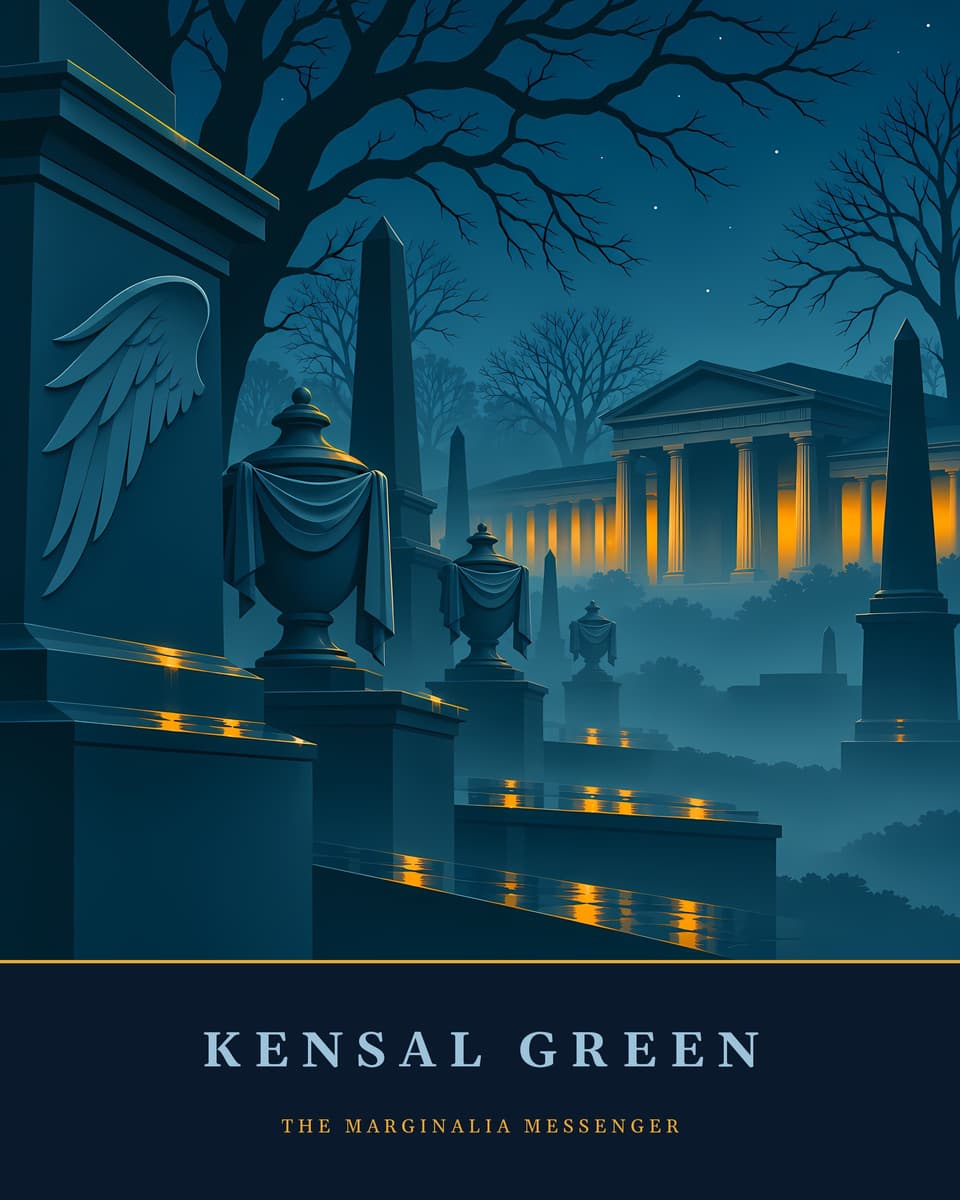
By the 1820s London's churchyards were full beyond any decent limit. They were also contaminating the water supply. The barrister George Frederick Carden had visited Père Lachaise in Paris in 1821 and come home convinced that his own city needed a cemetery laid out like a park. His efforts produced the General Cemetery Company, an Act of Parliament in July 1832, and a site of 54 acres between the Harrow Road and the canal, bought by the banker Sir John Dean Paul for £9,500.
Kensal Green was consecrated by the Bishop of London on 24 January 1833. It was the first of the seven great commercial cemeteries that ringed Victorian London, which the historian Hugh Meller named the Magnificent Seven in 1981, after the Western.
Greek against Gothic
Paul wanted a classical cemetery; Carden wanted Gothic. In 1831 an architectural competition drew 46 entries, and in March 1832 the prize went to Henry Edward Kendall's Gothic design. The directors then overruled their own judges. The chapels and the main gateway were designed instead by John Griffith, who had been one of the judges, in the classical style Paul preferred. Hugh Ronalds of Brentford planted fifteen thousand trees.
The first burial, in January 1833, was of Margaret Gregory, wife of Barnard Gregory, a journalist who made his living from other people's scandals. The cemetery soon did better. The Duke of Sussex, a son of George III, asked to be buried here and was, in 1843. His niece, Queen Victoria, was less impressed, and wrote in 1846 that his monument was "quite unfit for a prince of the blood". Princess Sophia, his sister, followed in 1848, and after that Kensal Green was the place for a fashionable funeral.
A lift to the catacomb
The Anglican Chapel stands on a raised terrace above Catacomb B, one of three under the cemetery, still in use, with room for about four thousand coffins. At the end of a service, a hydraulic catafalque lowered the coffin through the chapel floor into the catacomb. The Friends of Kensal Green Cemetery restored the mechanism in 1997, and it can be seen on their guided tours. In the southern wall, disused gates once opened onto the canal, so that barges could carry away the earth from new graves.
Babbage's brain, Blondin's omelette
About 250,000 people are buried here, in more than 65,000 graves. Isambard Kingdom Brunel lies here with his father, Marc. Charles Babbage is here too; he designed calculating engines and fought a long campaign against organ grinders in the street. Only part of him is here: half of his brain is preserved at the Hunterian Museum and the other half is on display at the Science Museum.
Charles Blondin crossed the Niagara Gorge on a tightrope on 30 June 1859 and went back many times, once stopping in the middle to cook and eat an omelette. He died at his house in Ealing, which he had named Niagara, in 1897, and was buried here. The circus horseman Andrew Ducrow has one of the largest and most ornate tombs, a Graeco-Egyptian affair with sphinxes and a winged horse. Its inscription says it was built "by genius for the reception of its own remains". In 1856 the magazine The Builder called it "ponderous coxcombry".
Kensal Green today
Kensal Green station (Bakerloo line and Overground) serves the main gate on the Harrow Road. Inside, the paths wind between ivy and leaning stones, well away from the road.
Find Kensal Green on the map of the novel's London · The Marginalia Messenger