Holborn
The Marginalia Messenger's London
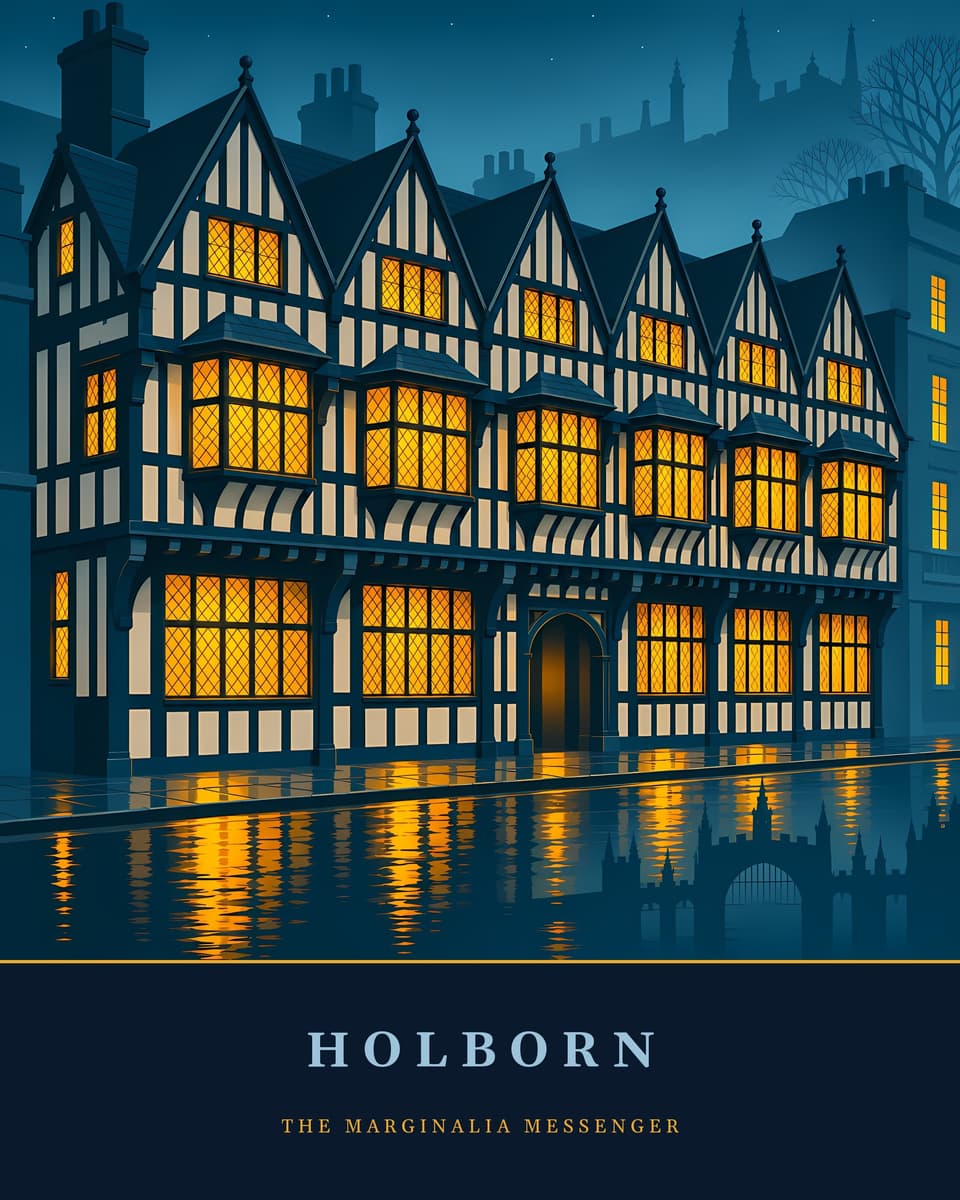
Holborn is the long road that runs east from St Giles towards the City, and the district around it. The name probably comes from the hollow of the River Fleet, which once crossed the valley at its eastern end; London put the river in a pipe in 1732 and has been walking over it since. Holborn turns up in the 2025 chapters of The Marginalia Messenger.
Strawberries and a single red rose
From the late thirteenth century the Bishops of Ely kept a London palace here, and its gardens were said to grow the best strawberries in the city. Shakespeare used them. In Richard III the Duke of Gloucester asks the Bishop of Ely to send for some, shortly before he has Lord Hastings beheaded. Holinshed, Shakespeare's source, dates that morning to 13 June 1483.
In 1576 the bishop, Richard Cox, leased much of the estate to Sir Christopher Hatton, a favourite of Elizabeth I, who is said to have first caught her eye on the dance floor. A Victorian history gives the rent as a red rose, ten loads of hay and ten pounds a year. The bishop kept a right of way through his own gatehouse and the right to gather twenty baskets of roses each year. Hatton then spent heavily on repairs and claimed the freehold. A royal commission ruled in 1577 that Cox could keep the property only if he paid Hatton back in full, which he could not.
The story is usually told with a furious letter from the Queen that opens "Proud prelate". It is said to have first appeared in print in 1761, nearly two centuries late, and at least one Victorian reference work calls it a forgery. Hatton Garden still carries the favourite's name. Ely Place, the gated cul-de-sac built on the palace site, is said to have counted as part of Cambridgeshire until the 1930s.
Wool, weighed and taxed
Staple Inn, the black-and-white timber front on High Holborn near Chancery Lane, dates from 1585. Tradition links its name to the wool staple, where wool was weighed and taxed before it could be sold. Generations of smokers knew it without ever visiting, because for a time it appeared on packets of Old Holborn tobacco. A German bomb badly damaged it in 1944, and it was restored afterwards.
Up Holborn Hill
For centuries the road dropped into the Fleet valley and climbed out again. In 1494 Henry VII paid to have it paved, since it was too deep and muddy to be safe. Prisoners from Newgate and the Tower went up the hill on their way to be hanged at Tyburn or St Giles.
The Victorians settled the matter with an iron bridge. Holborn Viaduct carried the road straight across the valley; it was built from 1863 and opened by Queen Victoria on 6 November 1869. Statues of four men from the City's past stand on its corner buildings, among them William Walworth and Sir Thomas Gresham.
Jumbo on the viaduct
On 12 January 1882 Thomas Edison's company began making electricity at 57 Holborn Viaduct. It is described as the first coal-fired public power station in the world. Its American dynamo was nicknamed Jumbo (after P.T. Barnum's circus elephant), and at first it fed 968 lamps along the street, later about 3,000. The site belonged to the Crown and could not be extended. The station lost money every year, and it closed in September 1886.
Holborn today
Chancery Lane station is opposite Staple Inn, with Holborn station further west. On winter afternoons Staple Inn's upper windows are lit above the traffic.
Find Holborn on the map of the novel's London · The Marginalia Messenger