Hampstead
The Marginalia Messenger's London
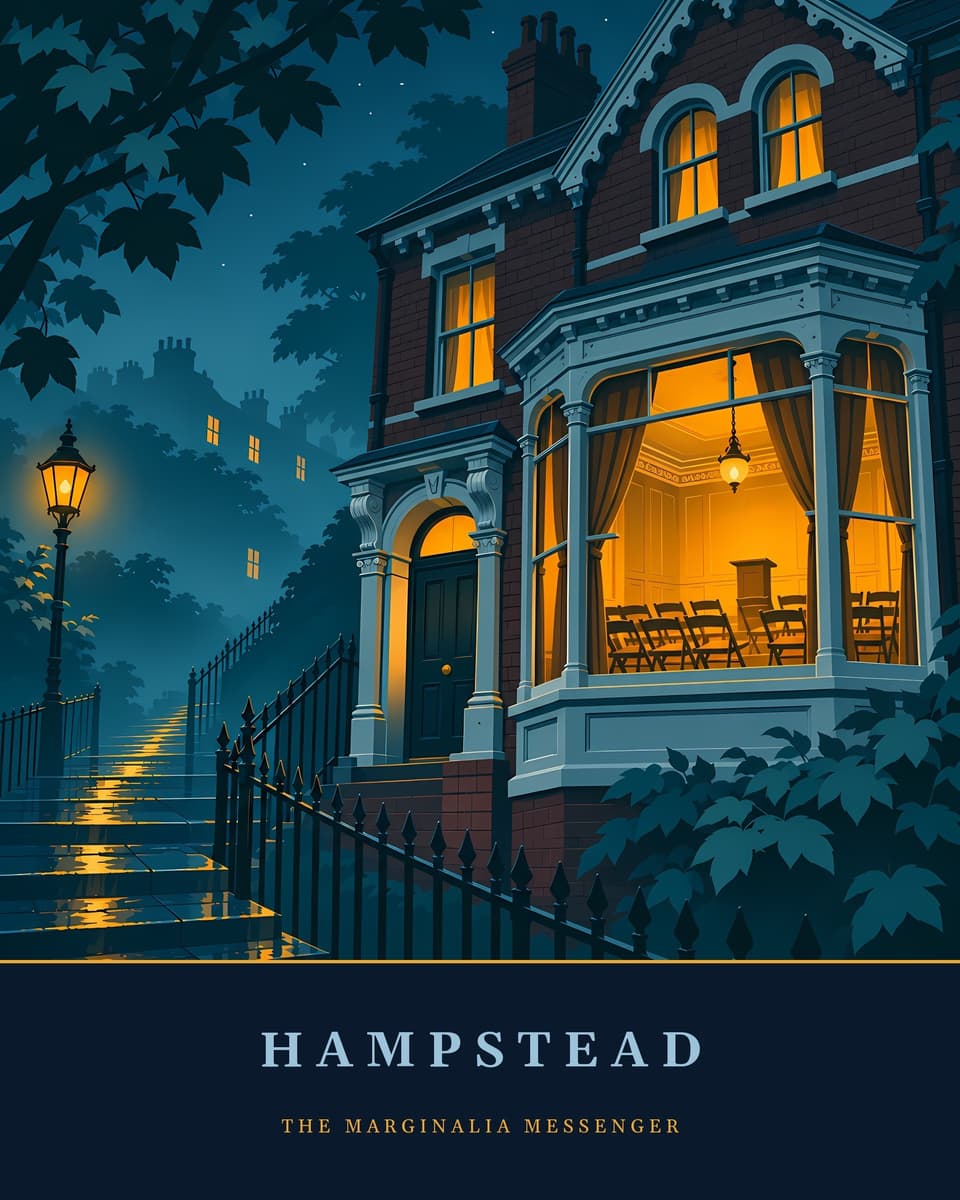
"In what had once been the front parlour, auction staff had arranged rows of folding chairs facing a small podium."
In the first chapter of The Marginalia Messenger, Liv Harrington takes the Northern line up to Hampstead on a wet morning for a late professor's estate auction and goes home with a crate of Victorian novels. The house is invented; the hill, north of the West End with the Heath behind it, is not.
Water by the flask
In 1698 Susannah Noel gave the parish some springs of iron-tasting water, for the benefit of the poor. The trustees of the new Wells charity wasted no time. By 1700 they were advertising it in London and selling it in flasks as far away as Charing Cross and Cheapside; Flask Walk is named after the bottles.
Concerts and dances followed, then card tables. A comedy put on at Drury Lane in 1705, called Hampstead Heath, showed a resort where "the dice rattle". By 1709 people complained of swindlers and prostitutes among the visitors, and around 1724 Daniel Defoe noticed that ladies careful of their reputations had begun to go elsewhere. In 1725 the spa's Great Room was turned into a chapel.
Twenty-one-year leases
Sir Thomas Maryon Wilson inherited the manor in 1821, and with it a problem. His father's will allowed him leases of only 21 years, too short for anyone to build on. He spent the rest of his life trying to change that. A bill of 1829 failed, and another in 1830. He planned 28 villas; landslips and water ended the scheme.
He died in 1869, his villas still unbuilt. The Metropolitan Board of Works then bought the Heath for £45,000, and an Act of 29 June 1871 required it to be kept "unenclosed and unbuilt on". The same year Parliament created the first bank holidays, and the fairs and day trippers arrived. By 1885 the Heath was crowded every holiday, the spa's old Long Room had been pulled down, and a drinking fountain in Well Walk marked the spring. There was still no Tube.
A plum tree and a hundred donkeys
John Keats moved into Wentworth Place, now Keats House, in December 1818, paying his friend Charles Brown £5 a month and half the drinks bill. Brown later said that Keats wrote "Ode to a Nightingale" in the spring of 1819 under a plum tree in the garden. That rests on Brown's word alone.
In 1821 and 1822 John Constable was out on the Heath painting clouds, which he called "skying". On the backs of dozens of small oil studies he wrote the date, the hour, the wind and the weather, as though expecting to be cross-examined. He is buried with his wife Maria at St John-at-Hampstead.
By 1836 about a hundred donkeys worked the Heath for hire. In the early 1850s Karl Marx rode them on family outings, with more enthusiasm than skill, according to the county history.
A highwayman from the wrong Hempstead
The Spaniards Inn, out on the Heath, likes to say that Dick Turpin drank there and that his father kept the place. It is a legend with little behind it. Turpin was baptised in 1705 at Hempstead in Essex, where his father kept an inn, and Black Bess and the ride to York come from Rookwood, a novel of 1834. Real highwaymen did use this road, though. In October 1751 one Samuel Bacon was caught close to the inn.
Hampstead today
Hampstead station (Northern line) opened in 1907 and has the deepest platforms on the Underground. On a grey day the ponds, and the paths with the long views over London, are close to empty.
Find Hampstead on the map of the novel's London · The Marginalia Messenger