Guildhall Library
The Marginalia Messenger's London
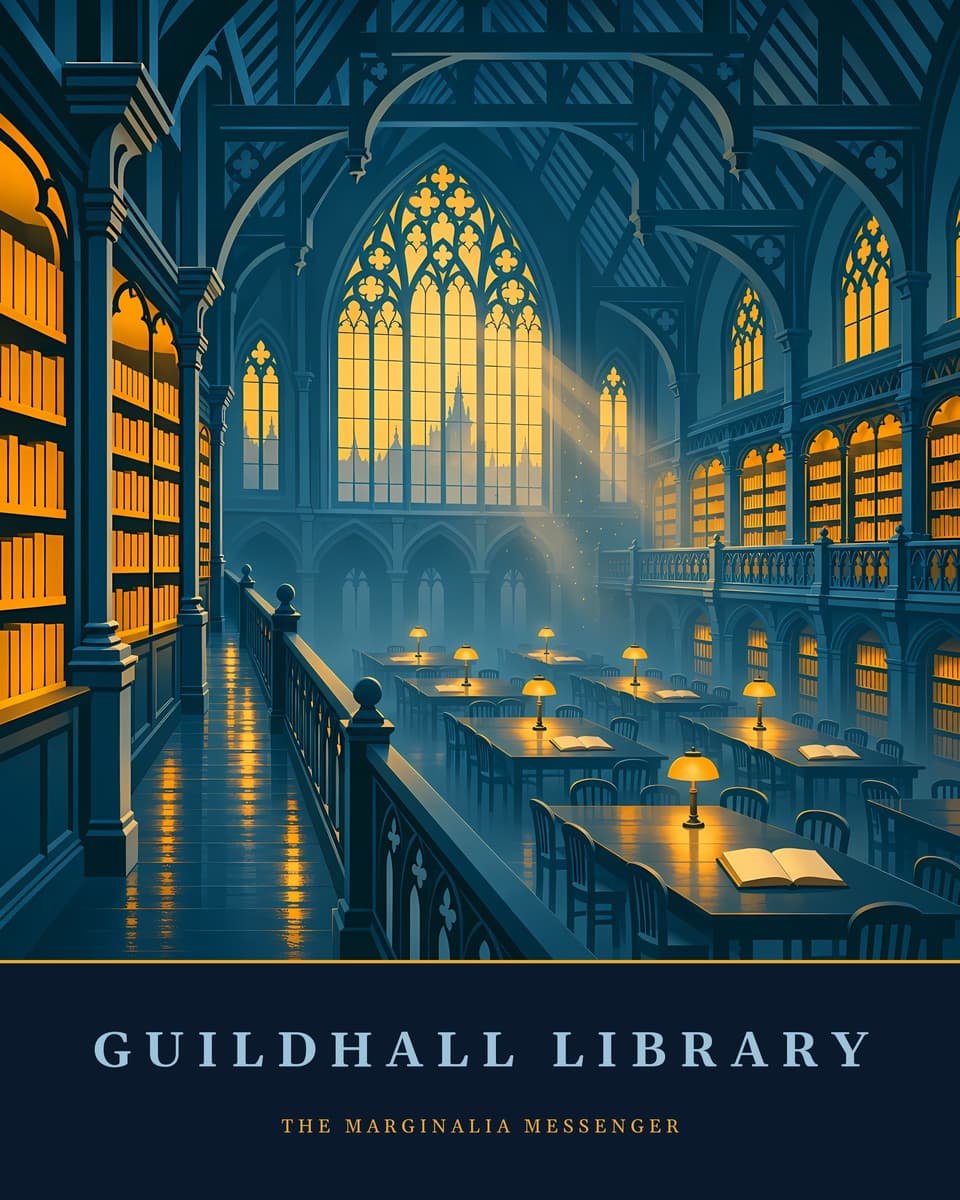
Guildhall Library is a public reference library on the history of London, tucked into the West Wing of Guildhall, just off Gresham Street. Anyone may walk in and read. Its shelves run to cookery, wine, ships, business and the City's own past.
A loan, in three carts
Guildhall's original library was built in the 1420s by the executors of Richard Whittington, the Lord Mayor of pantomime fame. John Carpenter, the City's Common Clerk and one of those executors, probably ran it until his death in 1442. John Stow later called it a "fayre and large" library.
In 1549 William Cecil, secretary to the Lord Protector, the Duke of Somerset, asked the City for a loan of the books. The City agreed. Three carts came for the books, and off they went, probably to the Duke's new mansion on the Strand, Somerset House. Stow noted, with some restraint, that they were never returned. Within a year the empty building had been let as a market house for selling cloth.
Three hundred years later
In 1824 a member of the Common Council, Richard Lambert Jones, put forward a motion to found a new library, and a committee went off to inquire into "the best mode" of doing it. The library opened in 1828 with William Herbert as librarian and about 1,700 volumes. An early extravagance was a complete set of the London Gazette, for 250 guineas.
It was not, at first, for everybody. Ratepayers turned down a free public library in 1855, and in the first six months of 1857 the library recorded just 532 visitors. In 1873 it opened to the public in a new Gothic building by Horace Jones, the City architect who went on to design Tower Bridge. That same year the Clockmakers' Company brought its library and museum to Guildhall.
Wine in the fish pond
In October 1974 the library moved again, into the new West Wing; moving the books took seven weeks.
By then food and wine had become two of the collection's great strengths. Elizabeth David, whose books brought Mediterranean cooking to a Britain where olive oil was scarcely to be had, came to read here, usually on a Saturday and arriving in the morning. According to a lecture given in 2012 by the library's principal librarian, she kept a bottle of white wine cool by lowering it in a string bag into the fish pond outside the door. She was a severe judge. An Ulster Women's Institute recipe for Italian salad was, in her words, "possibly the worst recipe ever devised".
Guildhall Library today
St Paul's, Bank and Moorgate stations are all close. On a weekday morning the reading room is very quiet.
Find Guildhall Library on the map of the novel's London · The Marginalia Messenger