Christ Church Greyfriars
The Marginalia Messenger's London
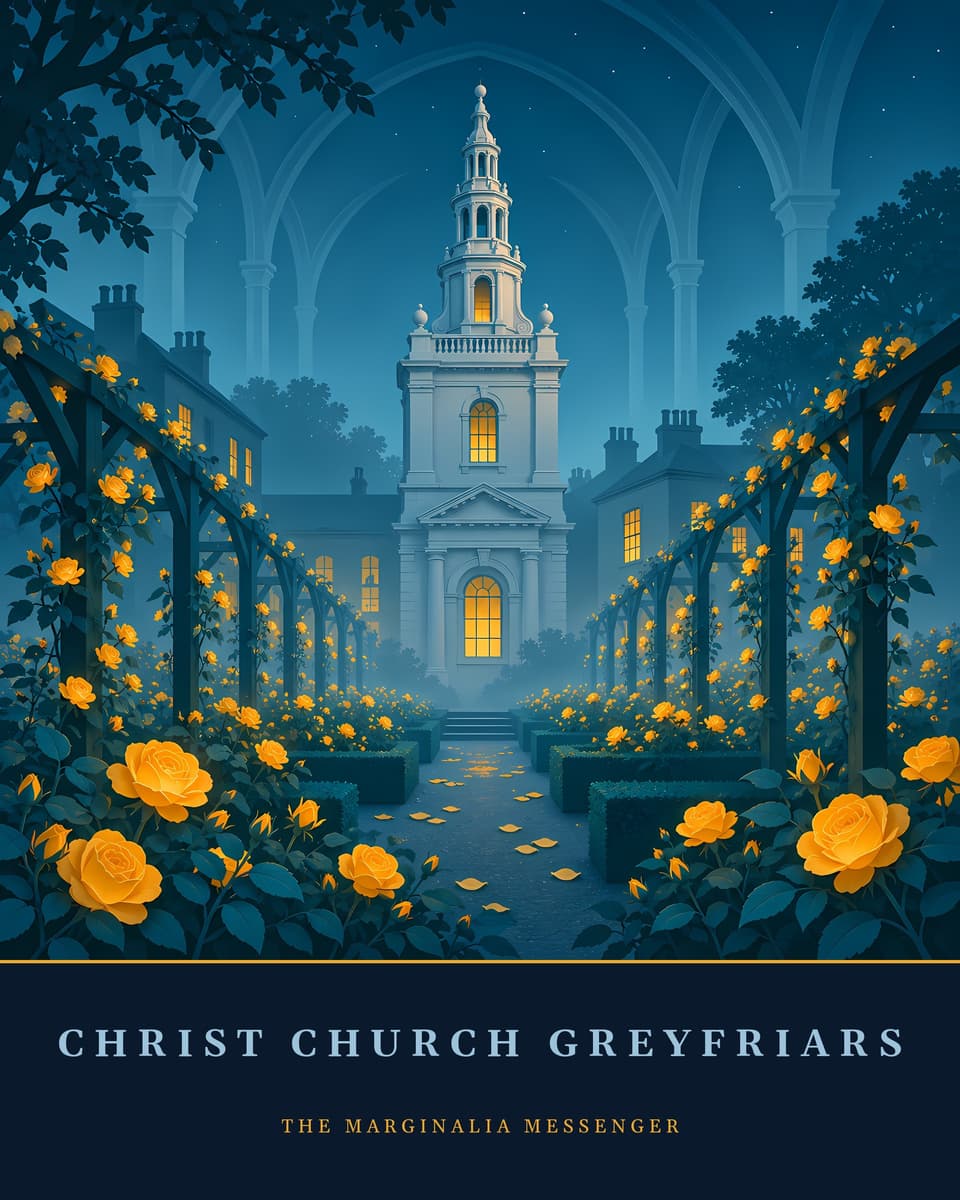
On Newgate Street, in the City of London, office workers eat their sandwiches among rose beds that follow the plan of a church. The box hedges mark the line of the nave; ten wooden towers, roses climbing them, stand where pillars once held up the roof, and the benches and pergolas sit roughly where the pews were.
Franciscan friars arrived in London from Italy in 1224 and were named for their grey habits. Their church here, finished around 1360, was the second largest in medieval London. Henry VIII dissolved the friary in 1538 and, in 1546, handed it to the City.
Blue coats and yellow stockings
In 1552 a school for poor children took over the old friary buildings. Christ's Hospital dressed its pupils in long blue coats, knee-breeches and yellow stockings, a Tudor uniform its pupils still wear (in 2011 more than ninety-five per cent of them voted to keep it). The church was their chapel, and some of the boys carved their initials into the woodwork.
Three of its pupils in the late eighteenth century were Samuel Taylor Coleridge, Charles Lamb and Leigh Hunt. Their upper master was James Boyer. He taught well and hit hard. Lamb remembered him doubling his "knotty fist" at a small boy before deciding to whip him after all. When Boyer was dying, Coleridge is reported to have said that it was lucky the angels carrying him to heaven had no bodies, or he would have flogged them on the way.
The school left for Horsham in 1902, and its buildings were pulled down. Former pupils are still known as Old Blues.
A sword-rest and a galleon
The medieval church burned in the Great Fire of 1666. Wren's replacement was finished in 1687, at a cost of £11,778, and its steeple in 1704. Each year the Lord Mayor came to hear the Spital Sermon and laid his ceremonial sword in a holder made for the purpose. The pews were said to be built from the timbers of a wrecked Spanish galleon, a story nobody seems to have checked and everybody liked. In 1837 Felix Mendelssohn sat down at the organ and played Bach's A minor fugue.
Roses where the pews were
A firebomb in the Blitz brought the roof and vaulting down into the nave. The church was not rebuilt. In 1962 the south and east walls came down to widen King Edward Street, and in 1989 the nave became the garden. In 2002 the road was put back on its old course and the site regained its pre-war outline. In 2006 Wren's steeple was converted into a private house on twelve levels, which must make for a great deal of stairs.
Christ Church Greyfriars today
The roses are out in June, when the traffic on Newgate Street seems further off than it is.
Find Christ Church Greyfriars on the map of the novel's London · The Marginalia Messenger