Covent Garden
The Marginalia Messenger's London
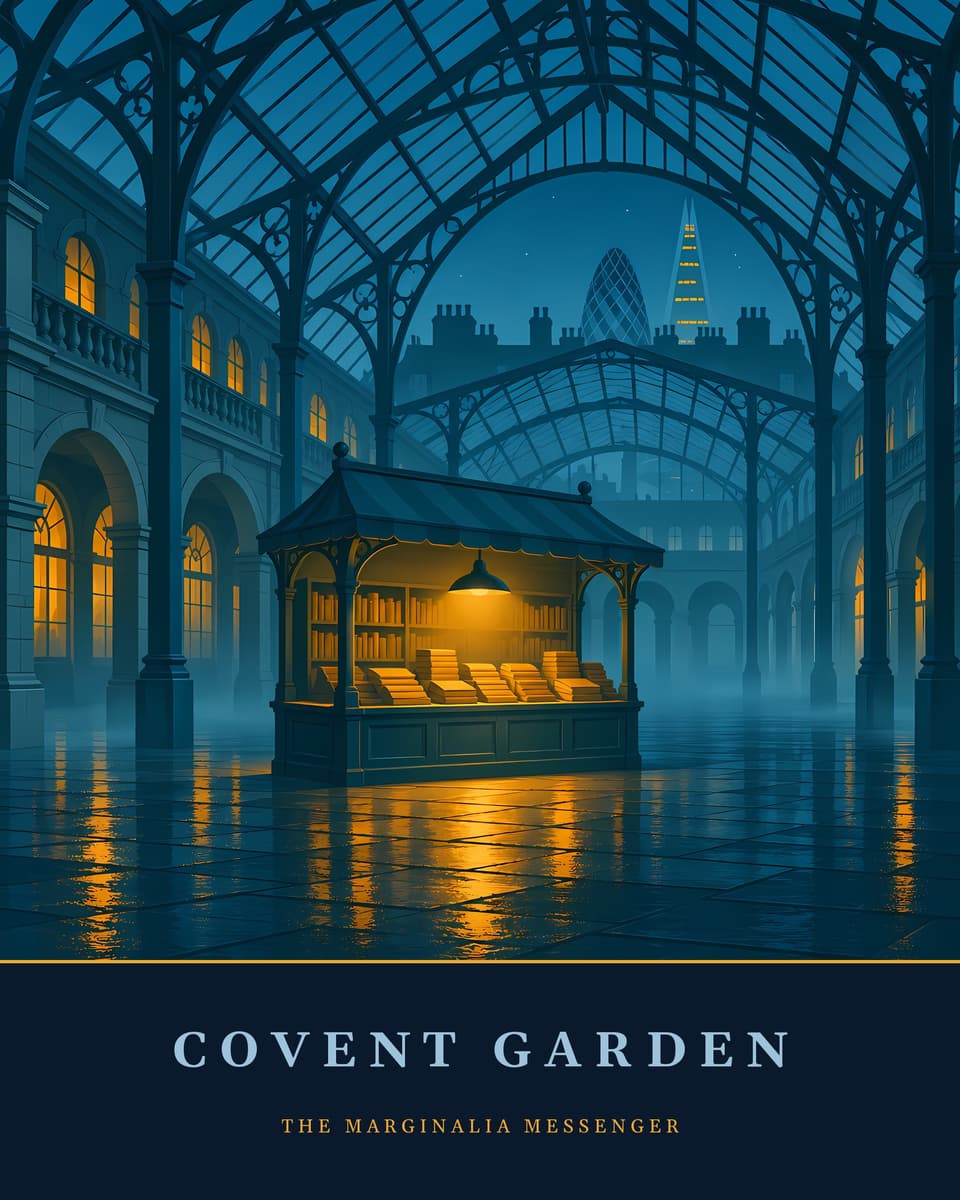
"…the sporadic hum of delivery vans bound for Covent Garden's morning activities."
Covent Garden was the convent garden of Westminster Abbey, where the monks grew their food, and it kept the name after Edward VI handed the land in 1552 to John Russell, Earl of Bedford. The Russells, later Dukes of Bedford, held it until 1918.
The handsomest barn
In the 1630s the 4th Earl hired Inigo Jones to lay out a piazza in the Italian manner, with arcaded houses and a church. London had never had a square like it. The story goes that the Earl, anxious about the bill, asked for a church not much better than a barn, and Jones promised him the handsomest barn in England. Horace Walpole printed the tale in 1765, on the word of the Speaker of the Commons, and at least one architectural historian calls it apocryphal.
The church of St Paul has a stranger feature, which is genuine. Its grand portico faces the piazza, but the doors under it lead nowhere; the altar had to stay at the east end, so the way in is round the back.
Mr Punch's first appearance
On 9 May 1662 Samuel Pepys went to see an "Italian puppet play" in the piazza and thought it "the best that I ever saw". The showman was Pietro Gimonde, known as Signor Bologna, and his play is counted as the first recorded appearance of Mr Punch in England. Punch's birthday is still kept at St Paul's every May.
By then a market had moved in. Traders with baskets and trestles were in the piazza by 1654, a royal grant of 12 May 1670 made it official, and the fashionable residents gradually moved out. In 1748 those who stayed petitioned against its "stench and filth". A lease of 1781 banned wild beasts and other shows, though a mountebank could stay if he packed his shed away each day.
Old prices
The Covent Garden theatre burned down in 1808. When John Philip Kemble reopened it on 18 September 1809, with higher prices and a new tier of private boxes, the audience objected, and went on objecting for about three months. Every night the "OP" rioters (for Old Prices) brought banners and noise, and once a mock coffin. Kemble hired the prizefighter Daniel Mendoza to keep order, which made it worse. In the end he lowered the prices and apologised.
Mud-Salad Market
In 1880 Punch attacked the market as belonging to "his Grace the Duke of Mudford" and called it a disgrace to London. In 1882 and 1883 the Duke offered to sell it to the Metropolitan Board of Works and to the City, and both said no. In 1886 the police were still complaining of its "scandalous condition".
In 1885 Covent Garden was still the Duke's working market, with Charles Fowler's colonnaded hall of 1830 and the iron and glass flower market of 1871 and 1872. Before dawn there was a jam of carts, porters with baskets stacked on their heads and flower sellers under the portico.
Plans to clear much of the area were stopped after a long local campaign, and in 1973 the government gave dozens of its buildings listed status. The market moved to Nine Elms in 1974, and the old market hall reopened with shops in 1980.
Covent Garden today
Covent Garden station (Piccadilly line) is the stop for the piazza, though Leicester Square is barely further. The street performers work under the portico of St Paul's, by the door that does not open.
Find Covent Garden on the map of the novel's London · The Marginalia Messenger