St Stephen Coleman Street
The Marginalia Messenger's London
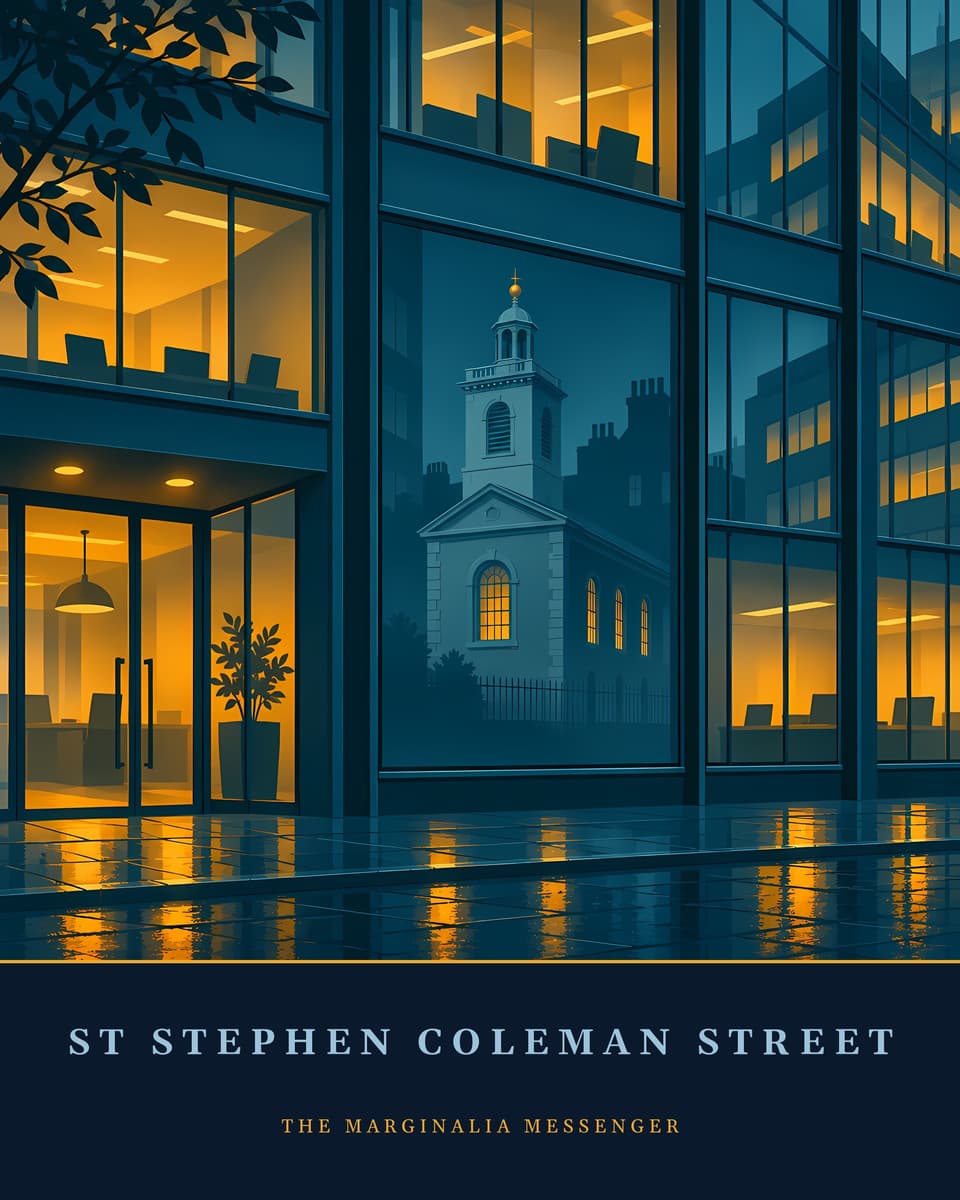
Coleman Street runs north from Gresham Street towards Moorgate, between office blocks. Nothing on it now looks like a church. For more than seven hundred years, though, St Stephen's stood here, a modest parish church with a habit of producing trouble for the authorities.
It appears in records as early as the reign of King John. In the 1290s a priory in Suffolk acquired the right to appoint its vicar without bothering to get a licence, and the dispute that followed was settled, in the priory's favour, in 1452.
A cock in a hoop
In 1431 a parishioner named John Sokelyng left money to the church, on condition that Masses be said for him and for his two wives. The gift was commemorated with a carved motif of a cock in a hoop, and the bird went on decorating the church for five hundred years. The two wives, as far as the records show, got no emblem.
The vicar who sailed away
By the early seventeenth century St Stephen's had become a Puritan stronghold, and the parishioners paid for their own improvements, a renovation in 1622 and a gallery in 1629. In 1624 John Davenport became vicar. He grew less and less comfortable with the Church of England. He resigned, and in 1637 he sailed for New England with the merchant Theophilus Eaton and a group of his former parishioners. The next year they founded the New Haven Colony, in what is now Connecticut.
His successor, John Goodwin, was an even more independent mind. He was turned out of the living in 1645 and briefly imprisoned after the Restoration.
A street for dissenters
In January 1642 Charles I came to the House of Commons in person to arrest five members he had charged with treason. They had been warned, and they took refuge in Coleman Street. During the Commonwealth that followed, the parish set up a committee of the vicar and thirteen parishioners to decide who was fit to take communion. Two of those thirteen had signed the King's death warrant.
Then, on 6 January 1661, came Thomas Venner. He was a cooper and a Fifth Monarchist, convinced that the rule of Christ on earth was due any day, and his congregation met in a rented room above a tavern in Swan Alley, off Coleman Street. He led them out to take the City. They marched to St Paul's, demanded the keys, and fought on and off for four days. Rumour put their numbers at five hundred. Samuel Pepys later heard that they were only about fifty. Venner was taken, wounded many times over, and on 19 January he was hanged, drawn and quartered, by most accounts in Coleman Street, outside his own meeting house.
St Stephen Coleman Street today
The church was bombed in the Second World War and not rebuilt, and its parish was joined to St Margaret Lothbury. Moorgate and Bank stations are both close.
Find St Stephen Coleman Street on the map of the novel's London · The Marginalia Messenger