Clerkenwell
The Marginalia Messenger's London
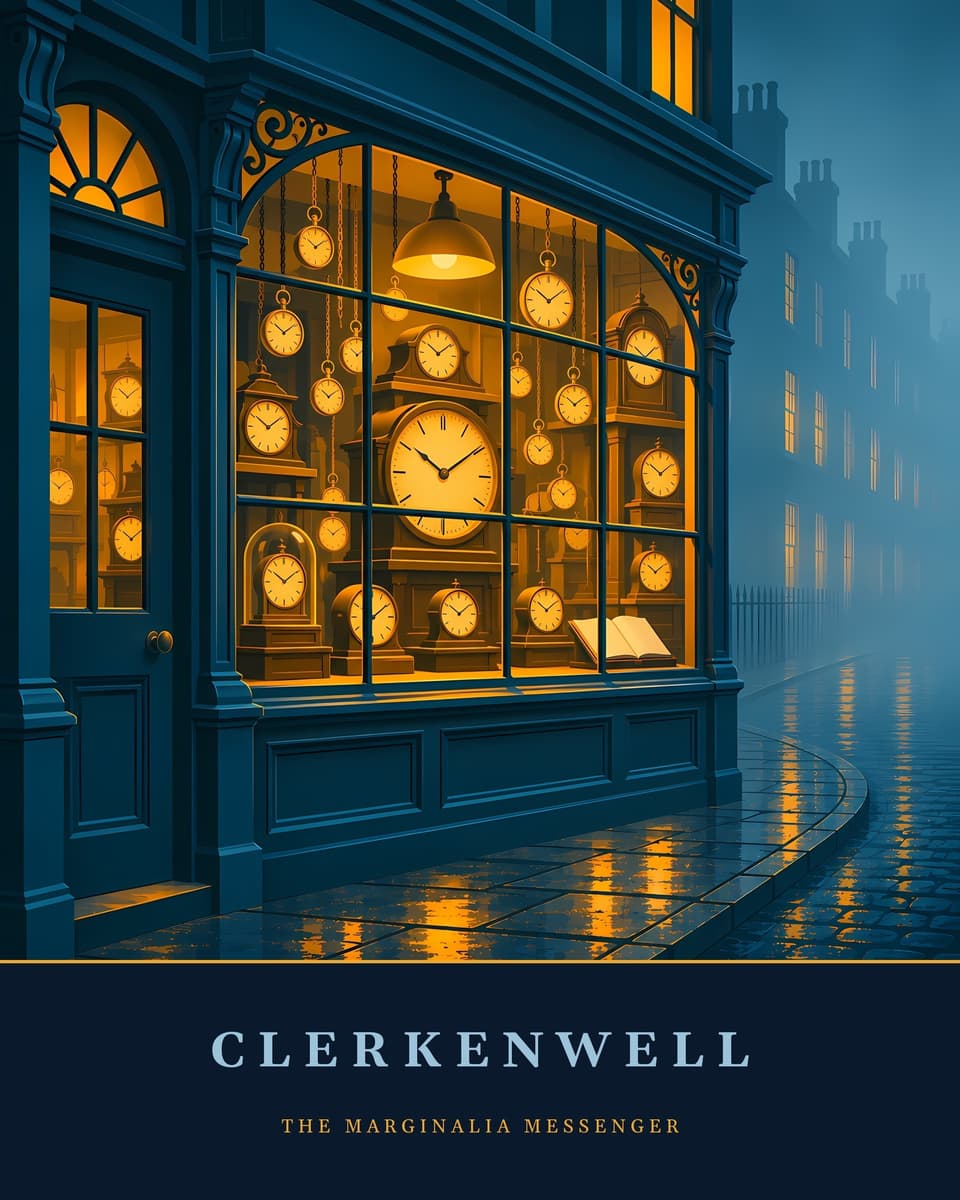
"Her lodgings in Clerkenwell occupied the social stratum that her situation required—respectable but modest, the dwelling of an unmarried woman of education but limited means."
In The Marginalia Messenger it is 1885 and Catherine Halford lodges here. Clerkenwell took its name from a well, and the well is still there, seen through a window at Well Court on Farringdon Lane.
Eight days from the Creation
In the Middle Ages the parish clerks of London met beside the wells here to act out scripture. According to John Stow, on 18 July 1390 they gave a play that ran for three days, with Richard II and his queen in the audience. In 1409 they went further and played for eight days, starting from the creation of the world. Stow places both at Skinners' Well, next door to the clerks' own.
Mr Sadler's well
Around 1683 a man called Sadler found a medicinal spring on his land and opened a "Musick-House" beside it, so that visitors could take the water with something livelier. Most sources call him Richard. Others say Thomas, and the Survey of London says Edward. By 1711 the place had a name as "a nursery of debauchery". It became a theatre, and in 1804 a giant water tank was installed under the stage for aquatic shows.
Joseph Grimaldi first appeared there as a small child, around 1780. At about six, playing a monkey that his father swung on a chain, he went flying into the orchestra pit when the chain snapped. In 1802, at Sadler's Wells, he created the whiteface clown called Joey, and for a time he played two theatres a night, running between Sadler's Wells and Drury Lane. His father, Giuseppe, once faked his own death to see how the children would take it, and left his daughter an extra £5 to cut off his head when he did die, in case he was buried alive. Grimaldi lies in a small park in Pentonville that now carries his name.
Watches and a wall
From the 1700s many of England's watches were made in Clerkenwell, in workshops and back rooms all over the parish. England's output peaked in the 1790s at close to 200,000 a year. Swiss and American factories then took the market, while Clerkenwell carried on making watches by hand.
On 13 December 1867 Fenians tried to free a prisoner, Ricard O'Sullivan Burke, from the House of Detention by blowing a hole in its wall. A first attempt the day before had fizzled. This time a barrel of gunpowder on a costermonger's barrow brought down a long stretch of the wall and wrecked the houses opposite in Corporation Row, killing twelve people. The police had been warned, so the prisoners had taken their exercise early, and nobody escaped. Michael Barrett was hanged for it outside Newgate in May 1868, the last public hanging in England.
By 1885 the new Clerkenwell Road had been cut through the old courts, and Italian families had settled around Saffron Hill.
Iskra on Clerkenwell Green
In 1902 Lenin rented an office at 37a Clerkenwell Green, a former Welsh charity school, and produced seventeen issues of his newspaper Iskra there before moving to Geneva in 1903. The building is now the Marx Memorial Library, which shows visitors the room where he worked, although that room did not exist in 1902.
Clerkenwell today
Farringdon is the station for Clerkenwell Green, and Angel the closer stop for Sadler's Wells. The workshops now hold architects and designers, and a few still mend clocks.
Find Clerkenwell on the map of the novel's London · The Marginalia Messenger