Charing Cross Road
The Marginalia Messenger's London
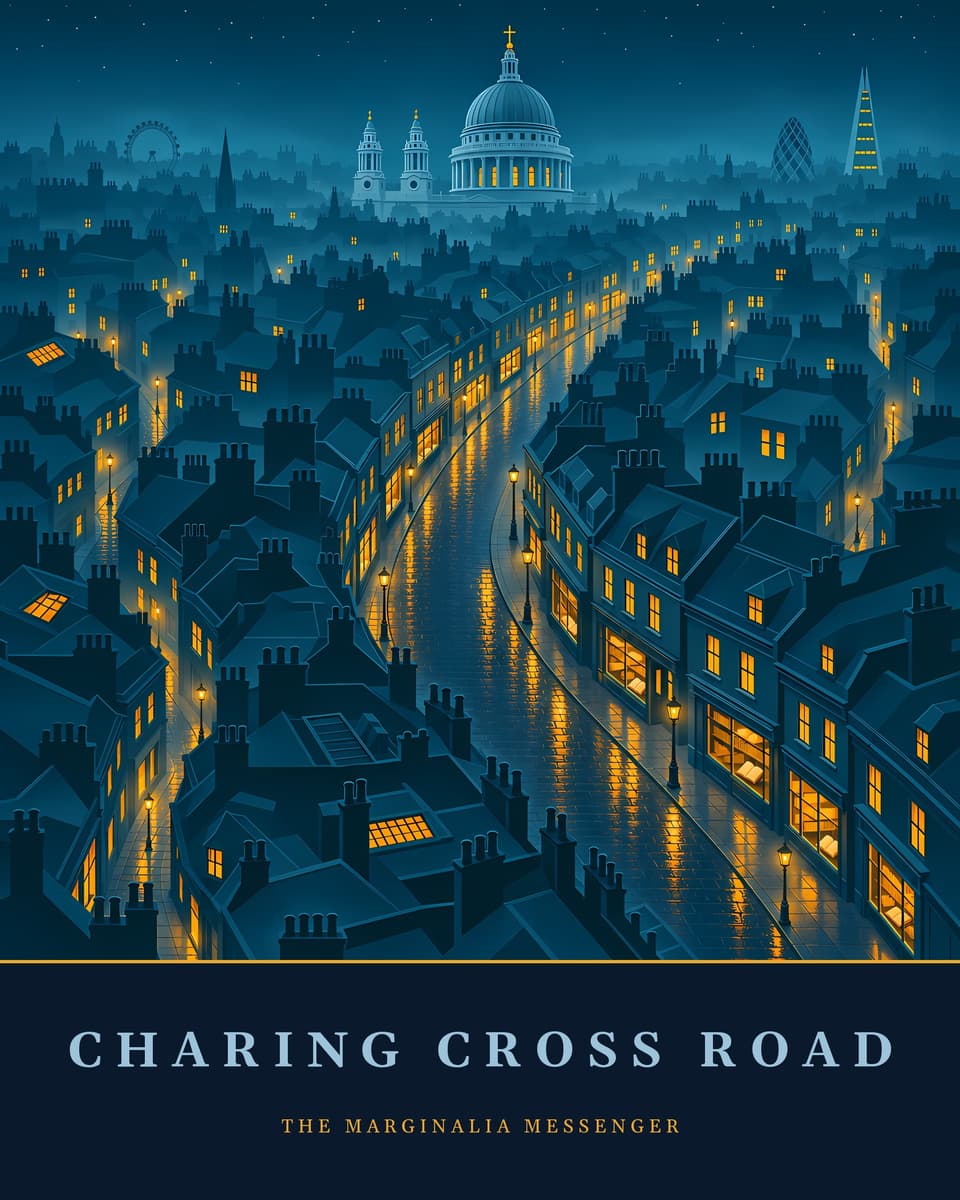
Charing Cross Road runs north from the edge of Trafalgar Square towards Oxford Street, and for most of its life it has been where Londoners go when they want to look at books. New ones are sold at the top end and old ones near Leicester Square. In between, shops have opened, moved, merged and closed with the regularity of a tide. In The Marginalia Messenger it is the street at the end of Liv Harrington's alley, Cecil Court, in the 2025 half of the story. Cecil Court was also the first West End address of the street's best-known shop.
Two brothers who failed an exam
In 1903 William and Gilbert Foyle failed the entrance examinations for the civil service. They advertised their textbooks, which were now of no use to them, and received more offers than they had books. They took the hint. After a start in Peckham, they opened in Cecil Court in 1904, and within two years Foyles had reached Charing Cross Road.
The story goes that when the Nazis began burning books, William Foyle telegraphed Hitler with an offer to buy them. The reply is said to have been a refusal: Hitler would "no sooner corrupt the morals of the English" than those of the Germans.
Three queues and a poem
William's daughter Christina took charge in 1945 and ran the shop until her death in 1999. A customer queued once for an invoice, again to pay at a booth and a third time to collect the book, because the assistants did not handle money. There were no calculators or electronic tills. Books were shelved by publisher, which suited the publishers. In 1980 Wendy Cope won a New Statesman poetry prize with "Foyled", a parody of Edward Thomas's "Adlestrop", and later in the decade the rival chain Dillons asked Foyles's customers in its advertisements whether they had been "Foyled again".
Christina also began the Foyles literary luncheons in October 1930. Some 700 were held, with guests who included Charles de Gaulle and Haile Selassie.
A letter to No. 84
In 1949 Helene Hanff, a writer in New York who could not find the books she wanted, answered an advertisement from Marks & Co, antiquarian booksellers at 84 Charing Cross Road. Frank Doel, the firm's buyer, wrote back. For twenty years they kept writing. She sent lists, complaints and, while Britain was still short of food after the war, parcels for the staff; he sent books. She kept putting off the visit. Doel died in December 1968, the shop closed at the end of 1970, and their letters came out that year as 84, Charing Cross Road. When she finally reached London in the summer of 1971, she found the shop empty.
The book became a television play, a stage play and a 1987 film with Anne Bancroft and Anthony Hopkins. In the book she asks a friend bound for London to "kiss it for me" if they pass the door. A round brass plaque now marks the building. The ground floor has lately sold hamburgers.
Specialists
Anton Zwemmer's shop at No. 79 sold books on art from 1922 until 2002. Silver Moon, a women's bookshop, traded at No. 68 from 1984 to 2001. The second-hand dealers still cluster at the Leicester Square end, and J.K. Rowling put the Leaky Cauldron here because the road is "famous for its bookshops".
Charing Cross Road today
Foyles moved a few doors along to No. 107 in June 2014. Tottenham Court Road station is at the north end and Leicester Square station towards the south.
Find Charing Cross Road on the map of the novel's London · The Marginalia Messenger