Cecil Court
The Marginalia Messenger's London
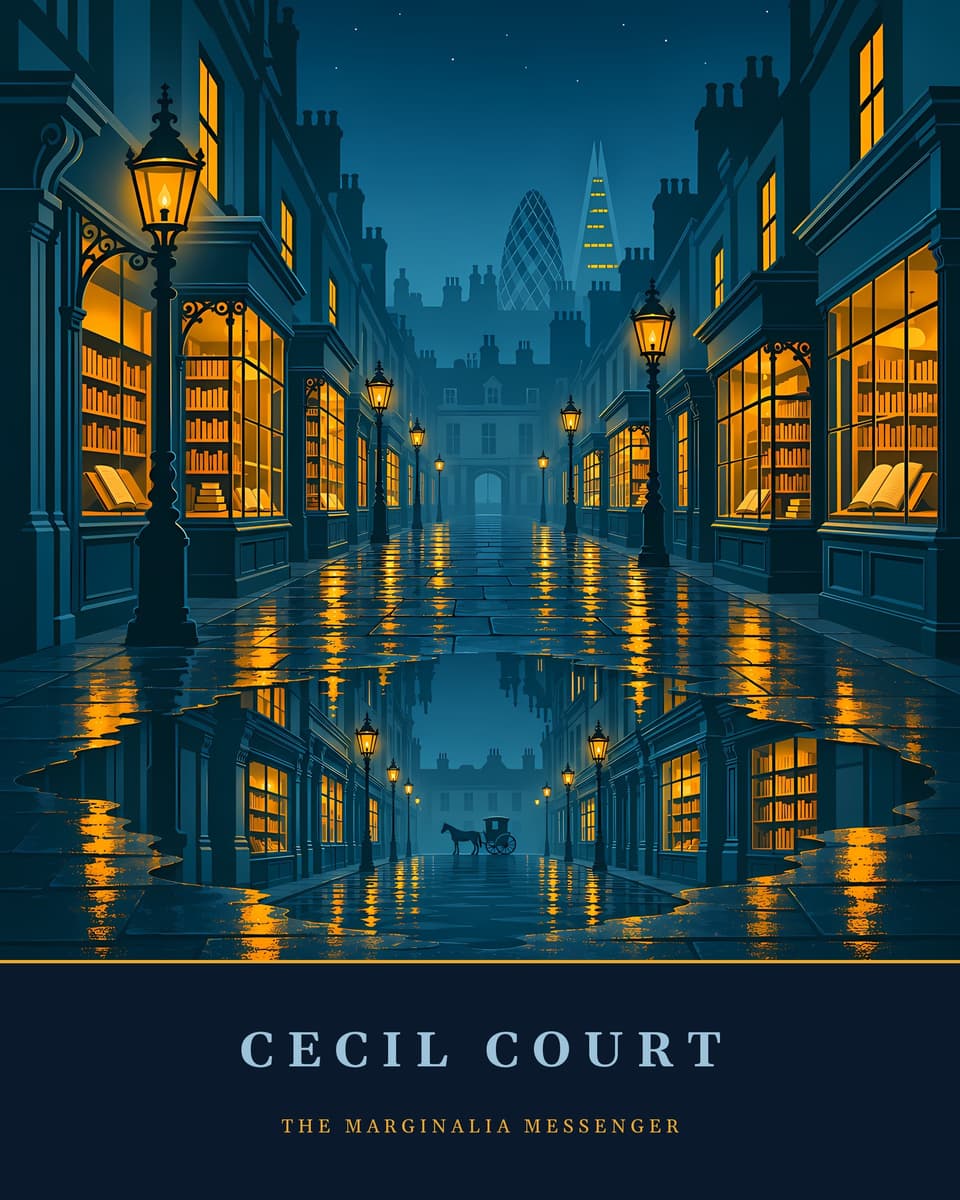
"The antique street lamps pooled amber light across the cobbles, creating pockets of shadow between their reach."
Cecil Court is a short passage between Charing Cross Road and St Martin's Lane, lined on both sides with glass shopfronts. Most of them sell something old, whether first editions, maps, prints or coins. In The Marginalia Messenger this is where Liv Harrington keeps her bookshop, between a coin dealer and a map seller, paying a Cecil Court rent and leaving a letter from the bank unopened.
The court has been here since the late seventeenth century. It has rarely been dull.
A barber, a boy and some flexible arithmetic
In April 1764 a family from Salzburg took three small rooms in the house of a barber, at what is now number 9. The barber was John Couzin. His lodgers were Leopold Mozart, his wife and their two children, Nannerl and Wolfgang. They paid twelve shillings a week, had no kitchen (meals were sent in) and stayed until August.
Couzin did more than cut hair. Tickets for the children's concerts were sold from his shop, and a newspaper advertisement that June sent the public to "Mr Couzin's, Hair Cutter, in Cecil Court". The same advertisements took a year or so off each child: Wolfgang, at eight, was billed as seven. Did he write his first symphony here? Some scholars think so; others prefer Ebury Street, where the family went next and near which a statue of him now stands. Cecil Court made do with a plaque, unveiled in 2011, which takes up less room.
The Prime Minister's rookery
By the 1880s the court was old, crooked and in poor repair. It belonged, as it still does, to the Cecil family, whose ancestor Robert Cecil bought the land in 1609. In 1888 the head of that family was also the Prime Minister, Lord Salisbury. When part of a roof gave way, the Star ran the story under the headline "The Premier's Rookeries Fall" and added that the public was paying two policemen to keep people away from the Prime Minister's property. The Star was a radical paper and Salisbury a Conservative, so the coverage was not entirely disinterested. The estate rebuilt it anyway, between 1889 and 1894, moving the line of the passage a few yards south. The red-brick fronts you see today date from then; the London of 1885 in the novel knew the older, shabbier court.
Flicker Alley
From 1897 a new trade arrived. Cinema pioneers took offices here, among them Cecil Hepworth, James Williamson, Gaumont and Vitagraph, and the trade paper The Bioscope was published from number 8. More than forty film businesses came and went before the First World War, and the passage became known as Flicker Alley. Early film stock caught fire easily. A steel door in one basement is said to date from the years when it was stored there. From 1914 the bigger companies moved west to Wardour Street, soon known as Film Row, and the booksellers took their place.
Booksellers' Row
Books had been sold here since at least 1704. In 1901 John Watkins moved his shop of mysticism and the occult to number 21, where it still trades. Its customers included W.B. Yeats and Aleister Crowley, who had fallen out badly over the Golden Dawn in 1900 and, one hopes, shopped on different days. William and Gilbert Foyle opened their first West End shop at number 16 in 1904. They outgrew it within two years, which is how Foyles came to be on Charing Cross Road. By the 1930s this was Booksellers' Row.
In 1983 an elderly gentleman went from shop to shop here, asking for a book called Fly Fishing by J.R. Hartley. Nobody had it. The advertisement was for the Yellow Pages, and viewers of a certain age can still quote it. Cecil Court is also often named as the model for Diagon Alley. J.K. Rowling has said that Diagon Alley is based on no real place, which has not stopped several London streets from claiming it, this one included.
Cecil Court today
The court is a short walk from Leicester Square station. It is at its best on a wet afternoon, when the windows are lit and nobody is in a hurry.
Find Cecil Court on the map of the novel's London · The Marginalia Messenger