The British Library
The Marginalia Messenger's London
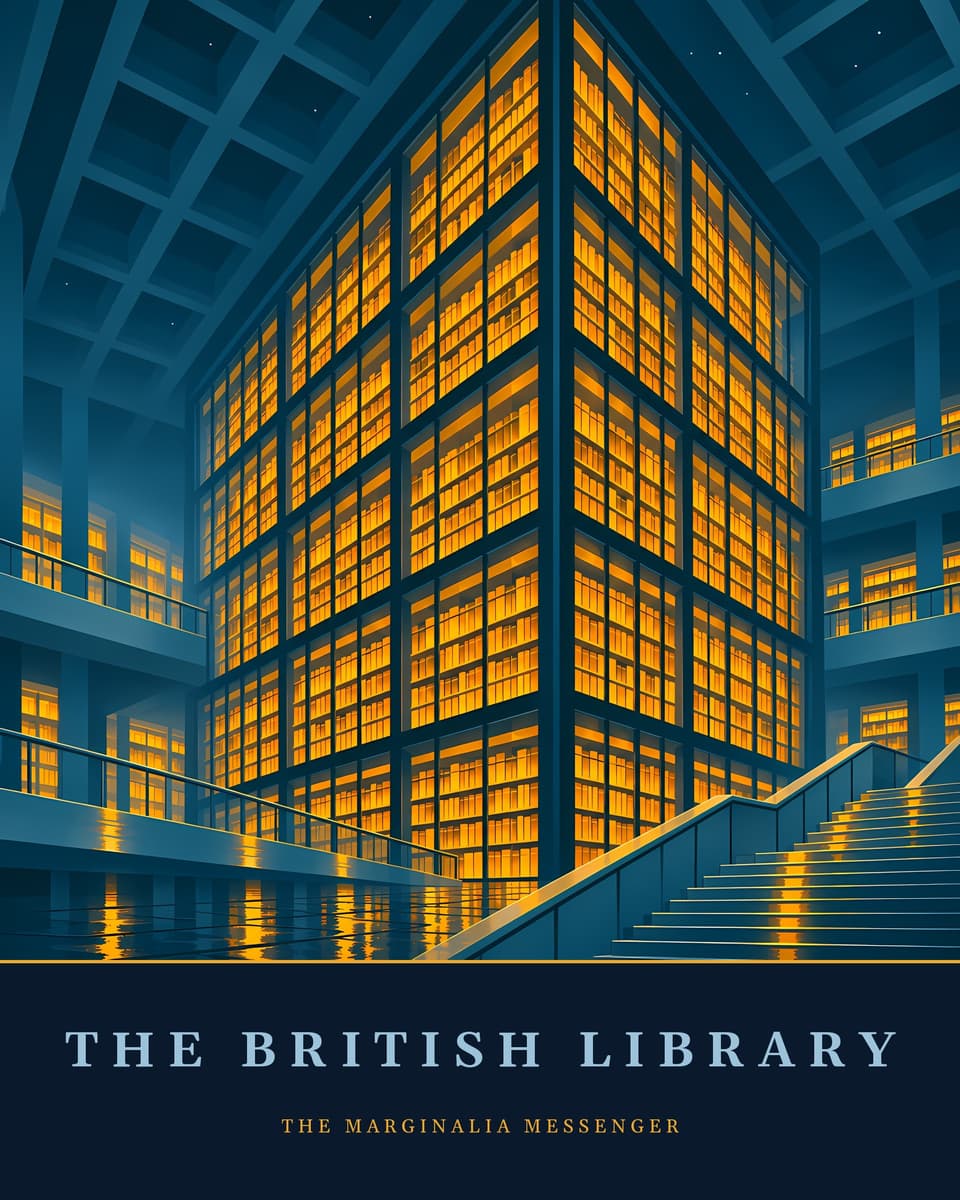
"The piazza before it was already populated with students and researchers, some reading on the stone steps, others queuing at the coffee cart near the entrance. Their conversations created a distant hum that faded completely once inside."
The British Library is on the Euston Road between Euston and St Pancras stations, a long building of red brick behind a broad piazza. The library appears in the novel's 2025 chapters. In 1885 neither the building nor the institution existed. The national library was then part of the British Museum on Great Russell Street, and the library as a separate body dates only from 1973.
Potatoes first
In 1885 this ground was a building site. In the early 1880s the Midland Railway used compulsory purchase powers to clear about five hectares of Somers Town, just north of the Euston Road. The landowners were compensated. Most of the people living there rented their rooms and received nothing. Between 1883 and 1887 the railway built a goods depot on two levels: sidings above, and below them offices, stores and a large potato market. The potato market stood where the library is now.
Archaeologists digging the northern half of the old yard later found, in the silt of a drain from the slum years, beads, a comb, a spoon and a small ceramic hare.
A thirty-year war
Colin St John Wilson started work on a new national library in 1962. The first plan put it in Bloomsbury, opposite the British Museum, at the cost of several streets of old houses; there was a long campaign against it, and the project moved to the railway land on the Euston Road instead. A design was approved in 1978. The general election of 1979 brought a new government, more delay and smaller ambitions as the costs rose. Wilson, who designed the library with his wife, the architect MJ Long, called it his thirty-year war.
Critics were not kind. The Prince of Wales is reported to have compared it to an academy for secret police. The books started to move after the British Museum's Reading Room closed on 25 October 1997, and Elizabeth II opened the library formally on 25 June 1998. In 2015 it was listed Grade I.
The King's books
At the centre stands a glass tower six storeys high. It holds the King's Library, about 65,000 printed volumes, with pamphlets, manuscripts and maps, collected by George III between 1763 and 1820. The idea came from a similar tower at Yale's Beinecke Library.
British newspapers reported that George IV was thinking of selling his father's library to the Tsar; nobody knows whether there was anything in it. In January 1823 he offered the collection to the nation instead. From 1827 to 1997 it lived in a long gallery at the British Museum, and then it moved here. Readers can still ask to see the books.
Out on the piazza sits Eduardo Paolozzi's bronze of Isaac Newton, based on a study by William Blake.
The British Library today
Euston and St Pancras stations are both close by. The piazza fills early.
Find the British Library on the map of the novel's London · The Marginalia Messenger