Blackfriars
The Marginalia Messenger's London
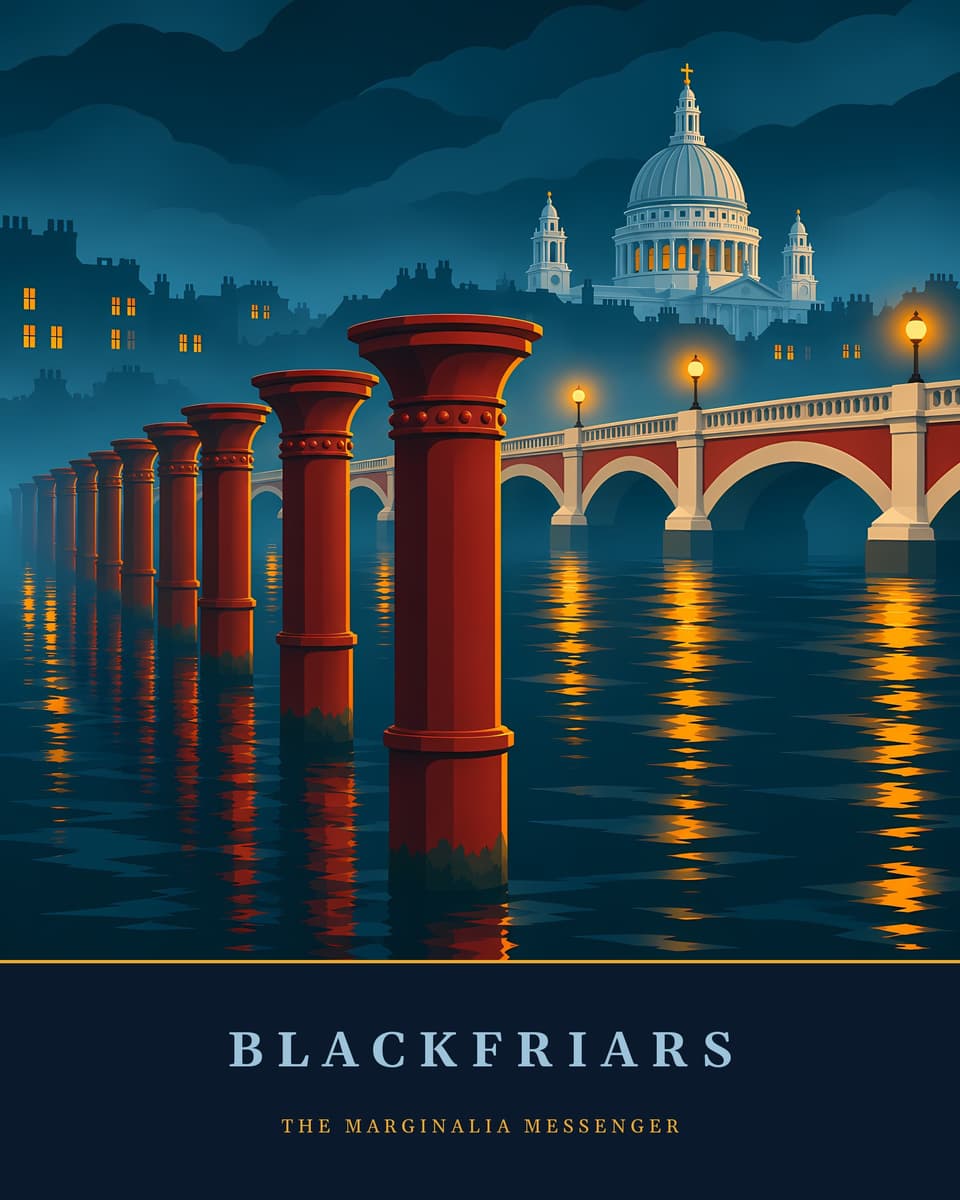
Blackfriars takes its name from the Dominicans, who wore a black outer cloak. In about 1276 they moved their priory from Holborn to the south-west corner of the City, between Ludgate Hill and the Thames. The friars have been gone for nearly five centuries. The name stayed, and it has since been given to a bridge, a station, a road and a pub.
A royal divorce
A large priory near the river was useful to kings. Parliament and the Privy Council met here, and in 1522 the Emperor Charles V was received at Blackfriars on his state visit to London. Seven years later the same buildings housed the hearing at which Henry VIII sought to end his marriage to Catherine of Aragon. In 1538 the priory was dissolved.
A playhouse the neighbours did not want
In 1576 Richard Farrant, a royal choirmaster, leased part of the old buildings and put on plays there with child actors. The lease ended in a lawsuit in 1584. In 1596 James Burbage bought the priory's old refectory for £600, meaning to open an indoor theatre for his company of adult players. The residents petitioned the Privy Council to stop him. The Council agreed. One of the signatures on the petition belonged to George Carey, Lord Hunsdon, who had just become the patron of Burbage's own company.
Boy players moved in instead. Only in 1608 did Burbage's company, by then the King's Men, take the theatre back, with Shakespeare among its seven sharers. From 1609 they played at Blackfriars in winter and at the Globe, across the river, in summer. Blackfriars was roofed and artificially lit, with music between the acts. In March 1613 Shakespeare bought the old priory gatehouse nearby for £140. He seems never to have lived there and to have held it as an investment.
Audiences could be hard to please. In November 1629 a visiting French company put actresses on the Blackfriars stage, and the women were hissed and pelted until they left it. The theatre closed with the others in 1642, at the start of the Civil War, and was pulled down on 6 August 1655.
Bridges and birds
The first bridge here opened in 1769. It was officially named William Pitt Bridge, a name Londoners ignored with complete consistency. Its replacement, designed by Joseph Cubitt and opened by Queen Victoria on 6 November 1869, has ends shaped like pulpits, a nod to the preaching friars who gave the district its name. On the piers John Birnie Philip carved water birds, with seabirds on the downstream side and freshwater birds upstream.
Beside it, a line of columns stands in the water with nothing on top. They held the railway bridge of 1864, which grew too weak for modern trains and was taken away in 1985. Its successor now carries a station roof covered in solar panels.
A pub full of friars
On the corner by the station stands the Black Friar, a wedge-shaped pub of about 1875. From around 1905 the architect Herbert Fuller-Clark and the sculptors Henry Poole and Frederick Callcott filled its interior with friars at work and at table. In the 1960s it was nearly demolished; a campaign led by John Betjeman saved it, and it is now listed Grade II*.
Blackfriars today
Blackfriars station, on the District and Circle lines and Thameslink, is on the doorstep.
Find Blackfriars on the map of the novel's London · The Marginalia Messenger