The Bank of England
The Marginalia Messenger's London
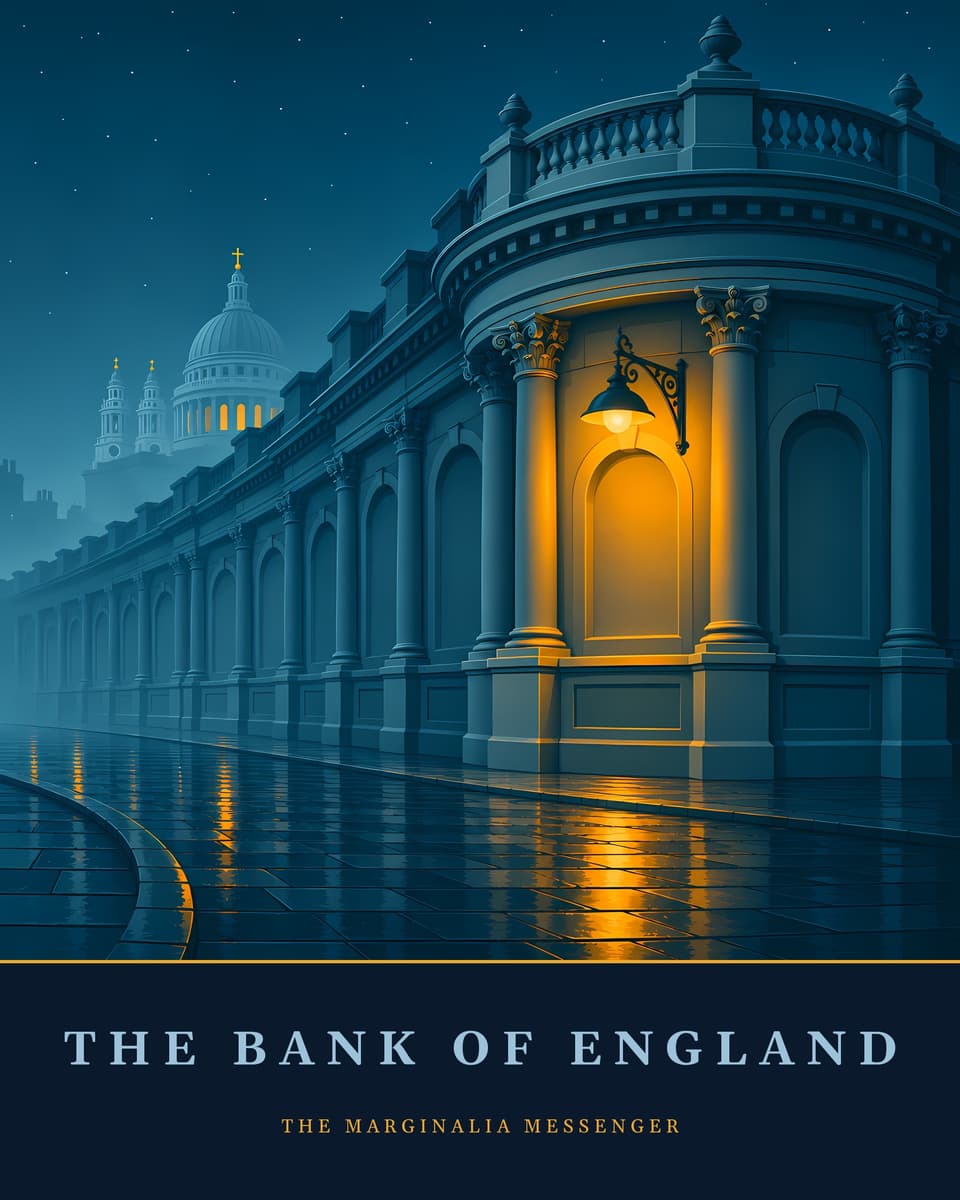
"Sir John Soane's neoclassical masterpiece dominated the intersection, its curtain wall of Portland stone stretching along the full block, punctuated by Corinthian columns."
The Bank of England fills a whole block at the heart of the City, with its main front on Threadneedle Street; it was founded in 1694 to lend money to William III's government for the war against France. A Scottish trader, William Paterson, had proposed the idea. The Bank opened in Mercers' Hall on Cheapside and in 1734 settled on its present site, where its first Governor, Sir John Houblon, had lived.
Three shots at the Secretary
In 1879 a nineteen-year-old Scot named Kenneth Grahame joined the Bank as a gentleman clerk. He did well. In 1898 he became its Secretary, the youngest it had appointed. In 1903 a man named George Frederick Robinson walked into the Bank and fired a revolver at him three times. Robinson missed with every shot, was overpowered, and was found guilty but insane at the Old Bailey. Grahame is said never to have quite recovered from the shock, and he retired in 1908, at forty-nine, officially on grounds of ill health.
An old lady, much admired
In May 1797 James Gillray published a cartoon in which the Prime Minister, William Pitt the Younger, pays unwelcome attentions to an elderly lady representing the Bank. Her dress is made of the new £1 and £2 notes. The title called her "The Old Lady of Threadneedle Street", and the name stuck so well that the Bank now uses it of itself.
Forty-five years of Mr Soane
The Bank grew by taking in its neighbours. Robert Taylor, its architect from the 1760s, enlarged the building and added wings to the east and west. On the west side stood the church of St Christopher-le-Stocks, in the way. During the Gordon Riots of 1780 a few people climbed onto it and hurled missiles across into the Bank, and in 1782 Parliament agreed that the church could go.
John Soane was appointed architect on 16 October 1788 and resigned in 1833, some forty-five years later. He rebuilt the Bank hall by hall behind a long blind wall that runs round the whole block. For the dome of his Rotunda he ordered twelve caryatids from Mrs Coade's manufactory in 1795, at a cost of £200.
In the 1920s and 1930s Herbert Baker replaced nearly everything inside that wall with the taller building you see rising above it today. Nikolaus Pevsner called it "the greatest architectural crime, in the City of London, of the twentieth century". Above the Tivoli Corner is Charles Wheeler's gilt bronze Ariel, the airy spirit of The Tempest, which Baker took as a figure for the lightness of credit and paper money.
The Bank of England today
Bank station has its exits on the junction, and the best view of Soane's wall is from the Tivoli Corner, under Wheeler's gilt Ariel.
Find the Bank of England on the map of the novel's London · The Marginalia Messenger