St Mary Aldermanbury
The Marginalia Messenger's London
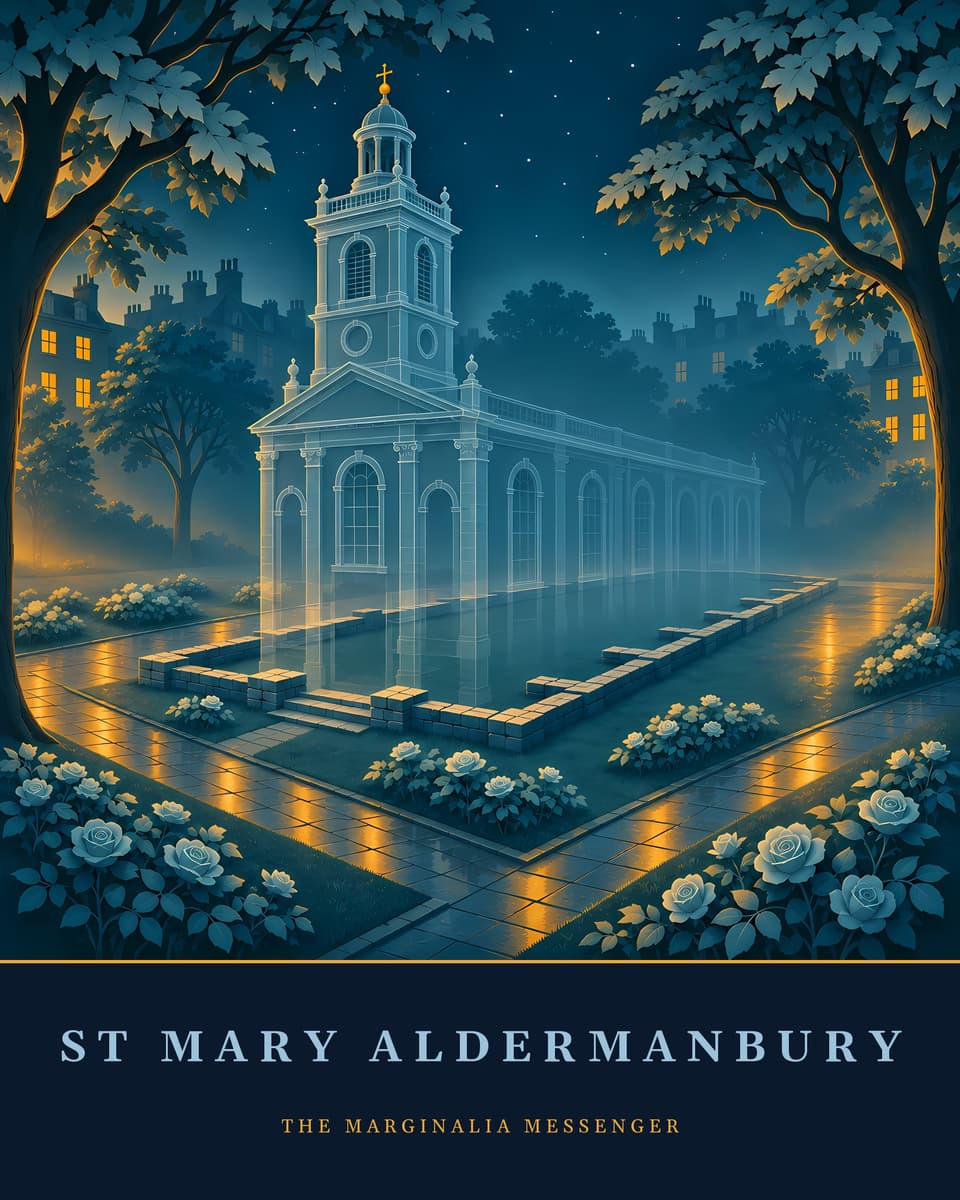
On the corner of Aldermanbury and Love Lane, a small garden of benches, trees and low walls traces the outline of a church. The church itself is not here. It is in Missouri, and has been since the 1960s.
St Mary's was founded early in the twelfth century and first mentioned in 1181; it burned in the Great Fire of 1666 and was rebuilt by Christopher Wren.
The preacher who only came to listen
Edmund Calamy became the parish's minister in 1639. In 1662 the Act of Uniformity required every minister to conform to the Church of England, and Calamy, who had a large following, would not. Like many others, he lost his post.
On 28 December 1662 he came back to St Mary's as one of the congregation. The preacher expected that day failed to turn up. The people pressed Calamy to take the pulpit, and he did, preaching on Eli trembling for the ark of God, with some warmth. On 6 January he was committed to Newgate on the Lord Mayor's warrant, the Act's first nonconformist prisoner.
London took it badly. So many visitors drove to the prison that their coaches blocked Newgate Street, and one Catholic lady, held up in the crush, told the King about it. Charles II ordered Calamy's release within the week. It turned out the Act had made no provision for keeping him in, a gap the House of Commons then sent to a committee.
A speech in Missouri
Fire came back in the Blitz, and this time Wren's church burned to a shell. The ruin was left for another twenty-five years, because there was no money to restore it.
Meanwhile, on 5 March 1946, Winston Churchill had stood up at Westminster College in Fulton, Missouri, to speak of an "iron curtain" descending across Europe. The speech was called "The Sinews of Peace", but two words of it are the ones people remember. In 1961 the college decided to mark the speech with a building, and it chose the ruin in Aldermanbury. The appeal raised $1.5 million, with Presidents Kennedy and then Johnson as honorary chairmen.
Across the Atlantic by ship
In 1965 the walls came down. About 7,000 stones were labelled before they were shipped. The architect Patrick Horsbrugh oversaw the rebuilding. More than 700 tons of stone crossed the Atlantic and then travelled by rail to Fulton. The foundation stone was laid in October 1966, and by May 1967 the last stone was back in place. On 7 May 1969 the Bishop of Dover rededicated the church, some four thousand miles from its parish. In 1990 Churchill's granddaughter, the artist Edwina Sandys, unveiled a sculpture beside it made from eight sections of the Berlin Wall.
St Mary Aldermanbury today
St Paul's and Moorgate stations are nearby. The London site was listed at Grade II in 1972. The garden was refurbished in 2024 with help from Westminster College, and on a weekday lunchtime its benches are among the quietest in the City.
Find St Mary Aldermanbury on the map of the novel's London · The Marginalia Messenger